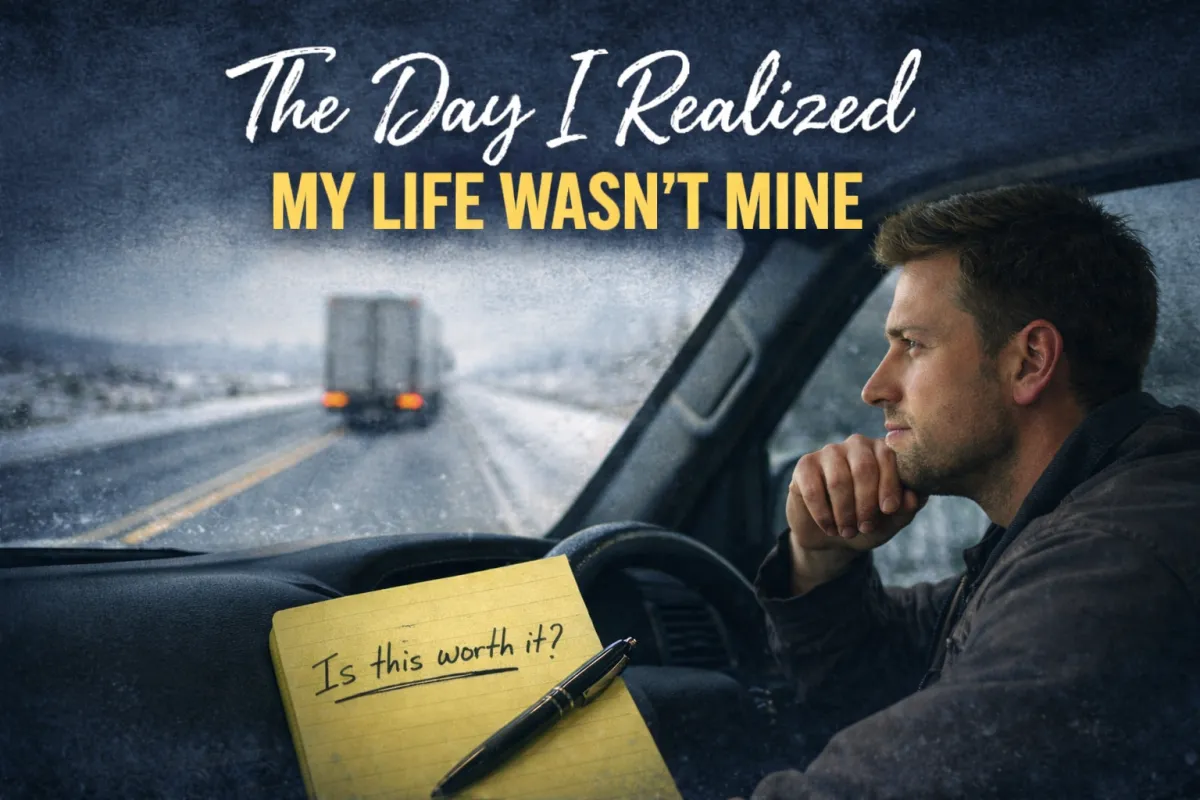
001 The Day I Realized My Life Wasn’t Mine
The Day I Realized My Life Wasn’t Mine
“The two most important days in your life are the day you are born and the day you find out why.” – Mark Twain
It was a cold, unforgiving winter day in Eastern Montana. The kind of day where the wind bites through even the thickest jacket and more concerning, one where the wind pushes your truck around on a road that gleams with an icy menace. I was driving down a narrow, two-lane highway, far from home and far from the life I wanted. My truck rumbled along, and I tried to focus on the road, but my mind wandered to my wife and two young boys waiting for me back home.
Suddenly, a car shot out from behind me and tried to pass both me and the semi-truck ahead, swerving into the passing lane on the slick, icy road. Time seemed to slow as I watched the car dart ahead of me, then quickly swerve back into my lane, cutting me off and nearly running me off the road to avoid a head-on collision—one that seemed obvious and inevitable to me but must have come as a surprise to them. Instinctively, I slammed on the brakes and veered slightly to the right, narrowly avoiding rear-ending them or becoming part of their potential head-on collision.
I pulled over to the shoulder, my heart racing and my hands trembling, gripping the wheel with white-knuckled intensity. This wasn’t the typical reaction you might have when someone cuts you off during your morning commute—the kind where you mumble a few unpleasant words under your breath or perhaps even let the other driver know they’re #1 in your book with a universal sign language gesture. No, this was different. What followed was an unsettling stillness, and a single question echoed in my mind: “Is this worth it?”
The Weight of Unfulfillment

That question wasn’t just about the near-miss. It was about everything. My job. My life. My priorities.
At 34 years old, I was married to the love of my life and the father of two amazing little boys. I was proud to be a provider, but deep down, I was running on empty. My job wasn’t terrible—I had a respectable title and a steady paycheck—but it demanded everything from me: my time, my energy, my presence.
I was on the road often, missing moments I could never get back. My wife, Becca, carried the weight of parenting alone while I was stuck in hotel rooms or navigating icy two-lane highways like this one today. I didn’t want to just be the guy who paid the bills. I wanted to be there. To actually be present—at bedtime, at baseball games, in the everyday beautiful chaos of family life.
Instead, I felt like my family was getting the leftovers of me. Whatever slivers of time and energy remained after my job had taken its share.
A Dangerous Question
As I sat there on the side of the road, engine idling and steam rising from the hood into the frigid air, a thought hit me like a lightning bolt:
“What if there’s another way?”
What if I didn’t have to live my life around a job? What if, instead, I built my income around the life I wanted?
The idea felt almost laughable at first. Like a pipe dream. But as I sat there, staring out at the snow-covered landscape, I couldn’t shake it. I glanced over at the yellow notepad sitting on my console and wrote the words that would change my life:
“My life and family should be the priority, and my income should serve it, not the other way around.”
That sentence wasn’t just a fleeting thought. It felt more like a declaration. A promise to myself that things would change.
Living on Leftovers
The truth was, deep down, I had known for years that something had to change. I had been carrying the scars of the Great Recession, a time that left me jobless and in foreclosure, forcing me to leave sunny California and the comfort of a six-figure job. I retreated to my hometown in Montana, taking a job that paid barely half of what I was used to, with far less prestige. At the time, I thought it was temporary—a stepping stone to rebuild myself. But here I was, several years later, stuck in a job that wasn’t just consuming my time—it was draining the life out of me and stripping away my autonomy.
Every time I rushed out of the office early, desperate to make it to my son’s baseball game, I could feel the weight of their judgment. The subtle glances, the raised eyebrows, and the snarky remarks stung like daggers. “Sneaking out early again, huh?” a colleague would quip, their tone dripping with sarcasm. Never mind that I’d been at my desk before the sun was even up, grinding away while they were still hitting the snooze button on their alarm. Their words lingered, a constant reminder of the battle between being a dedicated parent and proving my worth in a W-2 world that seemed to demand sacrifice at every turn.
I was tired of the guilt. Tired of the stress. Tired of feeling like my job owned me. My family deserved better. I deserved better.
The Birth of a Dream
That day on the highway, I didn’t have all the answers—if I’m being honest, I didn’t have any answers—but I knew I had just been hit with a lightning bolt of clarity. I didn’t know what my escape plan would be. But I knew one thing for sure: I was done living reactively. It was time to take control. It was time… to Boss Up and Live Free.
I set a bold goal—to generate $10,000 a month in side income outside of my day job. At the time, it felt daring—even a little unattainable—but it gave me a clear direction. It became my target, the focus of my energy and intention, and the spark to begin—not just a new chapter in my life, but a hero’s journey where I would be the main character.
Looking back, I realize I was still dreaming small, limiting myself to what felt realistic based on my current circumstances. That’s often how employees are conditioned to think—through the lens of SMART goals, performance reviews, and making sure the TPS report has the right cover sheet. I hadn’t yet learned how to dream big. That goal, ambitious as it seemed, was enough to ignite the spark and give me a clear target to focus on—one that, if achieved, would allow me to quit my job and live life on my own terms.
Time-Rich, Not Just Wealthy
It wasn’t just about the money. Sure, financial freedom was part of the dream, but what I craved even more was autonomy. I wanted to be time-rich.
I wanted the freedom to wake up and decide how to spend my day—to put my family first without the guilt of feeling like I was "sneaking out" or neglecting my work duties. I dreamed of building a life where my job didn’t own my time—a life where I was in control, calling the shots like a true boss, not just another employee bound by someone else’s schedule.
Time-Rich, Not Just Wealthy

It wasn’t just about the money. Sure, financial freedom was part of the dream, but what I craved even more was autonomy. I wanted to be time-rich.
I wanted the freedom to wake up and decide how to spend my day—to put my family first without the guilt of feeling like I was "sneaking out" or neglecting my work duties. I dreamed of building a life where my job didn’t own my time—a life where I wasn’t just another employee selling his best hours to build someone else’s empire.
The First Step
That day on the highway was my turning point. I didn’t have a fully-formed plan, but I had something even more powerful: a vision.
I realized that the unfulfillment I felt wasn’t just a burden—it was an opportunity. It was the seed of a dream. Sometimes, our deepest dissatisfaction is what pushes us to imagine a better future. I would turn my disadvantage into my advantage and use it as fuel to propel me forward on this path to a more fulfilling life.
I didn’t know what side hustle or niche would get me there, but I knew I was done settling and I was done dabbling.
Dreams Don't Build Themselves
As I sat in my truck, staring at the scribbled words on my yellow notepad, a wave of both excitement and excitement washed over me. I had no idea how I was going to turn this dream into reality, but for the first time in what felt like forever, I wasn’t just surviving—I was moving toward something meaningful. I’ve come to believe that, as humans on this spiritual journey, we thrive on progress. We all need a purpose, but we also need forward momentum and progress to feel truly alive.
Dreams rarely arrive fully formed. They begin as a spark—an unsettling question on a cold winter day, a sloppily scribbled note on a yellow legal pad, or a gnawing feeling in your gut. In hindsight, I now understand that it wasn’t my stomach at all. That restless tug was my soul—my unrealized potential—refusing to let me settle for a life of mediocrity, a life that feels pre-written rather than fully lived.
The Cliffhanger
So there I was, on that icy Montana highway, with a notepad full of dreams and no concrete plan. I didn’t know what the future held. I didn’t know how I was going to hit that $10,000 a month goal.
But I knew one thing for sure: I wasn’t going to let another year go by without taking action.
What happened next? How did I turn that dream into the life I live today? That’s a story for another day.
For now, I’ll leave you with this: If you’re unhappy or unfulfilled in your day job, if you’re tired of giving your family the leftovers, it’s time to start asking yourself the dangerous questions.
Because the life you want isn’t going to build itself.
To be continued…


