
What Is Land Flipping (And How Do People Actually Make Money Doing It)?
What Is Land Flipping (And How Do People Actually Make Money Doing It)?
““Risk comes from not knowing what you’re doing.” — Warren Buffett.”
Land flipping gets talked about like it’s either a scam or a cheat code.
Neither is true.
It’s a simple business model that works when it’s understood correctly—and fails fast when it isn’t. Most of the confusion comes from people thinking land flipping is about appreciation, timing the market, or finding some secret county no one else knows about.
That’s not how money is actually made in this business.
Land flipping is about buying land that is either undervalued by the owner or mispriced—from people who value certainty over hope—and reselling it to people who have fresh ideas and energy to utilize the land and are happy to pay full retail.
When done right, the deal makes sense the day you buy it. No hope. No appreciation required.
Let’s break down what land flipping actually is, how people really make money doing it, and where most beginners go wrong.
What Land Flipping Actually Is (And What It Isn’t)

Land flipping is a transaction business, not a speculation business.
You’re not buying land because you think it will be worth more in five or ten years. You’re buying it because it’s already worth more today than what you’re paying. This distinction matters—and it’s who this message is written for: land flippers, not buy-and-hold investors.
Most failed land deals fail because the beginner investor is itching to get their first deal done and forces one. They buy an average property—sometimes in a slow selling market—and hope marketing will bail them out. The speculator hopes appreciation or a builder will come along and save them.
That’s not flipping. That’s guessing.
Real land flipping works even if the market stays flat because the profit comes from price spread, not future growth.
I’m a huge fan of subdividing and value-add strategies that do force appreciation, but that’s different. In those cases, you’re controlling your own destiny. Even then, I still want to capture equity at acquisition to insulate myself from risk.
Land flipping is buying land at a discount from sellers who want speed, simplicity, or certainty—and reselling that same land to buyers who want usability, access, or opportunity, ideally with as little capital improvement as possible.
You’re bridging a gap, not predicting the future.
The seller and buyer are valuing the same parcel differently. Your job is to step into the middle and get paid for solving that mismatch.
People often ask, “Why would someone sell at a discount?” Because the land isn’t being used, and they emotionally and literally undervalue it.
Right now, I’m staring at a Peloton bike I bought new, used heavily for a year or two, and now sits unused in the corner. At some point, it stops making sense to keep staring at it—or using it as a coat rack. I’ll probably sell it for half of what I paid.
Land works the same way.
It may take a mental reframe, but it’s no different than a garage sale—letting go of electronics, clothes, or gym equipment you once paid full price for, got value from, and now just clutters your house or your mind.
Why Land Gets Mispriced in the First Place
Land is weird. That’s why this business exists.
Land is use-driven, not comp-driven. Institutional investors might call it an inefficient market. In simple terms, land value often has more to do with intended use than what the lot down the street sold for.
Houses are emotional and familiar. Everyone understands them. You can hop on Zillow or Redfin and figure out the price per square foot in minutes.
Land is abstract, boring, and often ignored. That’s where the inefficiency comes from.
Mispricing usually comes from absentee ownership, long hold times, inherited property, lack of use, or complexity avoidance such as taxes, paperwork, or mental overhead.
These landowners/prospective sellers aren’t stupid. They’re optimizing for something other than price.
They’ll trade upside for certainty. Speed for simplicity. Maximum value for relief.
On the other side, buyers—builders, recreational users, small developers, or long-term holders—see clear utility. They’re willing to pay market value because they know exactly what they’ll do with the land.
Your profit lives between those two perspectives.
The Basic Land Flipping Model
At its core, land flipping follows a simple sequence.
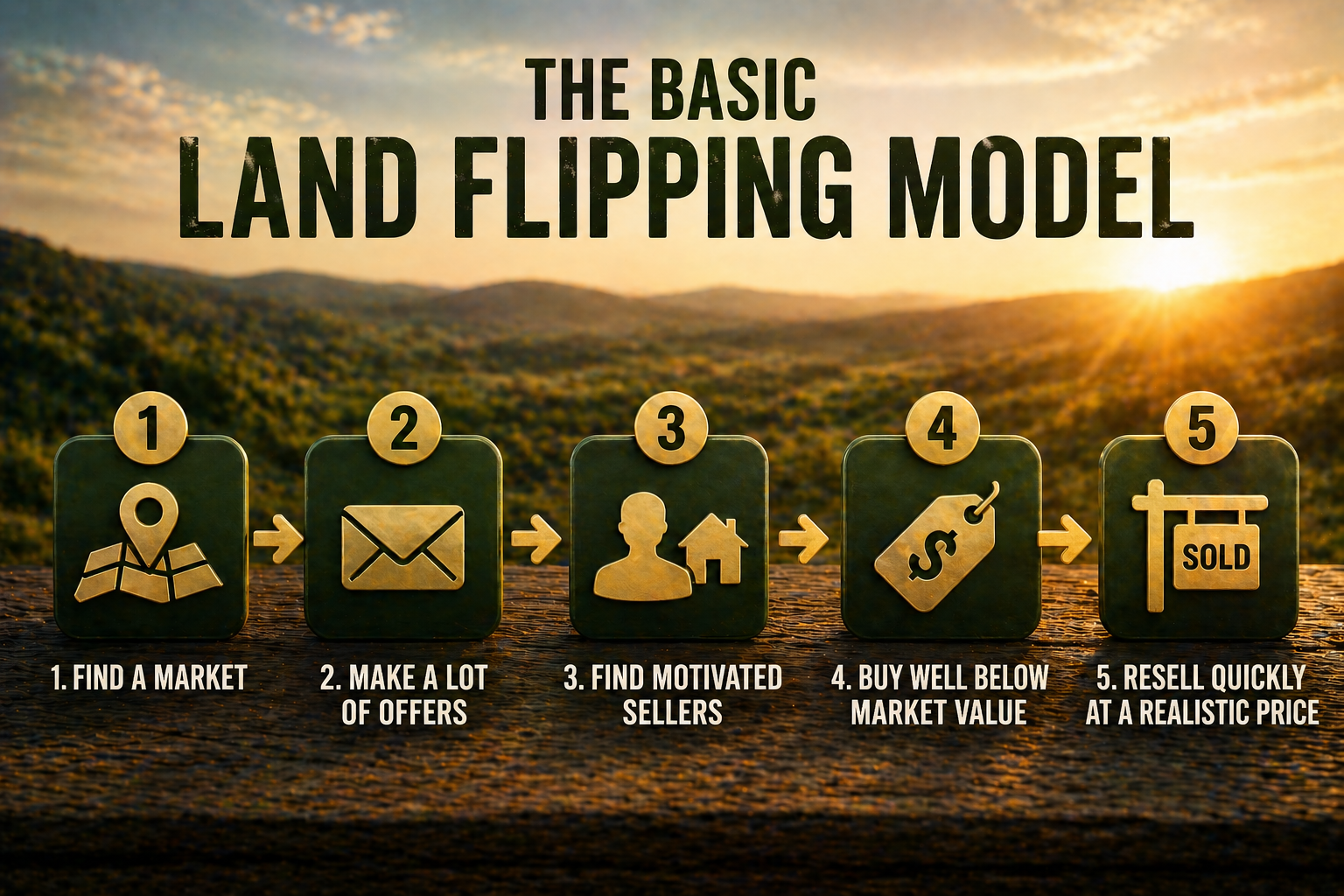
First, identify a market where land actually sells, preferably within six months or less. Look at sell-through rates and days on market.
Next, find owners likely to sell at a discount, such as out-of-state owners who have owned the property for fifteen years or more.
Then, make a lot of offers. You might get twenty-five to fifty no’s depending on how aggressive your pricing is, so offer volume matters.
Buy well below market value. Unless you’re starting with a more advanced strategy like subdividing, your focus should be on capturing equity at acquisition to insulate yourself from risk.
Finally, resell quickly at a realistic price. Most buyers sort listings from low to high. Pricing slightly below retail can move a parcel faster, and offering seller financing by accepting payments is another way to accelerate demand.
That’s it.
There are variations—seller financing, subdividing, assignments, options—but the core never changes. You’re buying low relative to real demand and exiting clean.
The mistake beginners make is overcomplicating this before they’ve ever done a deal. They obsess over the perfect market or the perfect strategy instead of execution.
Podcasts, courses, and communities help you get oriented, but this business is learned by doing, not theorizing.
How People Actually Find Deals
Deals don’t come from scrolling listings all day.
Listings are where sellers go after they’ve already anchored themselves to retail pricing. That doesn’t mean deals don’t exist on-market, but that’s not where consistent deal flow and spreads come from—especially for beginners.
Most land flips start off-market.
That means direct outreach to owners who are not actively trying to sell. You’re creating opportunities, not waiting for them.
Common lead sources include direct mail, cold calling, text messaging, and calling land agents.
The channel matters far less than consistency.
Most sellers aren’t motivated today. Some will be in six months. Situations change—divorce, death, job transfers, and life events all shift motivation.
Your first campaign has nothing to do with your second or your hundredth. Don’t obsess over response rates early on. The goal is to get conversations and make offers.
This is a business where no’s outnumber yes’s at least twenty-five to one. Don’t take it personally. A completed imperfect campaign beats a perfect one that never gets sent.
Why Market Selection Matters More Than Cheap Prices
New investors love cheap land. That instinct causes more problems than it solves.
Cheap land that doesn’t sell is just a liability.
The most important factor in land flipping is velocity. You need proof that land actually moves in the market you’re targeting.
Two signals matter most: sell-through rate and days on market.
If land sits forever, price doesn’t matter.
This is where beginners get trapped. They buy deeply discounted land in dead markets and then spend months or years trying to unload it.
Good markets forgive small pricing errors. Bad markets punish everything. Early mistakes here often determine whether someone continues or quits altogether.
The Real Way People Make Money on the Buy
Profit is made when you buy, not when you sell.
Selling is execution. Buying is judgment.
In most land flips, the purchase price falls between twenty-five and fifty percent of realistic market value, especially under fifty thousand dollars. As price increases, offers may need to creep higher.
The biggest lever isn’t the envelope or the font. It’s price.
People open their mail. They just don’t respond to bad offers.
When deals aren’t happening, the first things to review are marketing volume, whether real written offers are being sent, and how offer pricing compares to the market.
There’s no magic script that overrides math.
Why Micro Land Flips Are a Good Starting Point (But a Bad Destination)
Most people start with small land flips for good reasons. They require less capital, have a higher margin of error, involve simpler properties, and provide quick feedback.
That first win matters. It changes how people think.
But staying there long-term creates problems. Small flips are competitive, labor-intensive, hard to delegate, and dependent on volume.
They’re a training ground, not a finish line.

What Actually Makes a Land Deal Safe
Land feels simple, which is why people get careless.
I qualify deals quickly but not sloppily. Early screening prevents expensive surprises later.
There are a few non-negotiables: legal and physical access, no fatal floodplain or wetland issues, usable terrain, and a clear exit strategy.
If I can’t clearly answer who the buyer is and why they would want the land, I don’t buy it.
Fragile deals fail. I avoid them.
How the Sell Side Actually Works
Selling land isn’t complicated, but it is different from selling houses.
Most buyers search online. They want clear photos, clean descriptions, simple terms, and confidence that the land is buildable or usable for their intentions.
You don’t need top dollar. You need a market-clearing price.
That often means pricing slightly below comparable listings for cash buyers, making it easy to buy by offering seller financing, being responsive, and removing friction during due diligence.
Velocity matters. Capital tied up too long is risk, even if the deal looks good on paper.
The Role of Seller Financing and Deal Structure
Not every deal should be a straight cash flip.
Sometimes the price doesn’t work, but the structure does.
Some sellers want a clean exit. Some want monthly income. Some want tax deferral. Some value certainty over price.
Structure isn’t about being clever. It’s about alignment, and you only learn that by having real conversations.
The Mistakes That Kill Most Beginners
The same patterns show up repeatedly: buying in dead markets, overpaying because it felt cheap, holding too many slow parcels, ignoring exit strategy, and confusing activity with progress.
Ten slow properties aren’t diversification. They’re distractions that tie up capital.
Land rewards patience, clarity, and conservative pricing. It punishes optimism and impatience.
So… Is Land Flipping Real?
Yes. Very real.
But it’s not passive. It’s not automatic. And it’s not forgiving if you ignore fundamentals.
People make money flipping land because land is mispriced, misunderstood, and ignored. That creates opportunity for operators who treat it like a business.
Market consistently.
Buy well in fast-moving markets.
Price to sell realistically.
Manage risk.
Repeat.
That’s the game of land flipping.


