
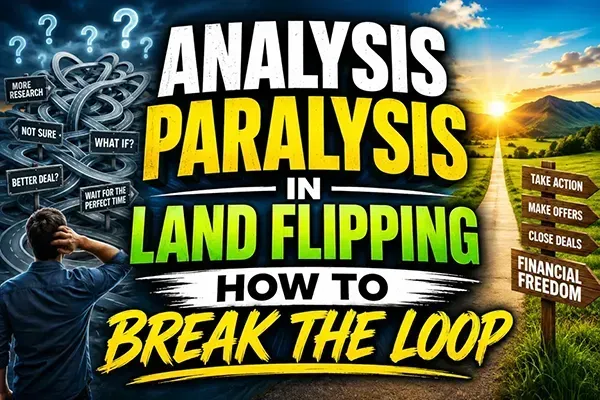
Analysis Paralysis in Land Flipping: How to Break the Loop
Almost everyone who wants to get into land flipping hits the same wall.
They don’t quit.
They don’t fail.
They just… stall.
Weeks turn into months of:
Watching YouTube videos
Listening to podcasts
Comparing counties
Watching more YouTube videos
Listening to more podcasts
“Just one more round of research”
From the outside it looks like you are being deliberate and disciplined.
From the inside it even feels responsible.
In reality, it’s analysis paralysis-and it quietly kills more land businesses than bad deals or lack of money ever will.
This article is about why smart people get stuck here, what’s actually happening in their head, and how real operators break the loop.
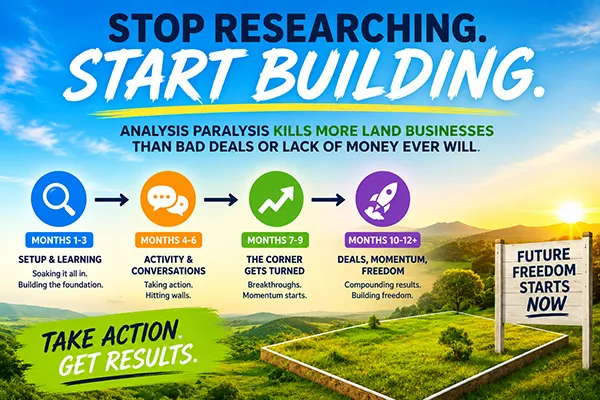
Why Analysis Paralysis Feels Like Progress
The most dangerous thing about analysis paralysis is that it feels productive.
You're not endlessly scrolling social media.
You're "working."
You're gathering data.
You're learning.
You're preparing.
You're researching.
So it doesn’t feel like avoidance.
But here’s the tell:
Nothing external is changing.
No offers sent.
No seller conversations.
No real feedback from the market.
Just motion without momentum.
Land flipping is not a knowledge problem. It’s a decision-making problem under uncertainty. And analysis paralysis is what happens when someone tries to eliminate uncertainty instead of managing it.
The Hidden Belief Causing the Loop
Underneath analysis paralysis is a quiet belief most people never say out loud:
“If I think long enough, I can avoid being wrong.”
That belief is comforting-and false.
Land flipping doesn’t reward perfect decisions.
It rewards good-enough decisions made consistently.
You can’t research your way to certainty because the most important variables don’t live in spreadsheets:
Seller motivation
Timing
Emotional pressure
Personal circumstances
Those only reveal themselves after action.
Waiting longer doesn't reduce risk. It simply delays information.
This was a real struggle for me. I spent years in engineering roles, working alongside engineers every day. We were trained to anticipate problems, analyze variables, and minimize uncertainty before taking action.
But land flipping rewards decisiveness.
You've probably heard the phrase, "Ready, fire, aim." While I don't advocate being reckless, I realized I had become the opposite. I was a "ready, ready, ready... aim, aim, aim... fire" kind of person.
The problem is that you can only learn so much from the sidelines. At some point, the next piece of information you're looking for only comes from taking action. Every offer you make, every seller conversation you have, and every deal you evaluate gives you feedback that no amount of additional research can provide.

Why Smart People Get Stuck Longer
Ironically, analysis paralysis hits thoughtful, intelligent people the hardest.
Why?
Because they:
Understand nuance
See edge cases
Respect downside
Want to “do it right”
That caution turns into overthinking when there’s no clear decision rule.
Instead of asking:
“Is this good enough to move forward?”
They ask:
“What else could go wrong?”
And that question has no bottom.
Research Has Diminishing Returns
There’s a point where additional research stops helping and starts hurting.
Early research:
Eliminates obvious mistakes
Narrows markets
Creates guardrails
Late-stage research:
Adds noise
Increases doubt
Creates false trade-offs
If you’ve:
Watched YouTube videos & listened to podcasts
Researched educators and courses
Research potential markets to flip in
…and you’re still researching, you’re no longer reducing risk. You’re avoiding commitment.
That’s the loop.
Operators Use Decision Rules, Not Perfect Answers
Here’s how experienced land investors avoid analysis paralysis:
They don’t wait for certainty.
They operate off decision rules.
Examples:
“If land sells here consistently, I proceed.”
“If I can explain the value in one sentence, I will move forward.”
“If the downside is limited and the exit is clear, I send the offer.”
Decision rules cap thinking.
They create an action threshold so you don’t renegotiate the decision every day.
Without rules, every new data point reopens the debate and nothing ever gets done.
Action Creates Clarity, Not the Other Way Around
This is the part most people get backward.
They think:
“Once I’m clear, I’ll act.”
In reality:
Clarity comes from acting.
Sending offers creates clarity.
Talking to sellers creates clarity.
Getting rejected creates clarity.
The market is the only honest teacher in this business.
You can’t simulate it in your head.
Why the First Move Feels So Heavy
The first real action-sending offers, making calls, committing to a market-feels heavier than it actually is.
Why?
Because it collapses optionality.
As long as you’re researching, every outcome is still possible.
Once you act, reality responds.
That response might be uncomfortable.
But it’s also the only way forward.
A Simple Way to Break the Loop
If you feel stuck, do this:
Pick a market you believe is good enough
Define one marketing channel and one clear offer strategy
Send a batch of offers
Commit to reviewing results-not feelings
Then stop thinking until the data comes back.
This turns vague anxiety into concrete feedback.
Silence is information.
Rejections are information.
Counters are information.
Information beats imagination every time.
The Difference Between Caution and Stalling
Caution asks:
“Is this reckless?”
Stalling asks:
“What if there’s a better option?”
Caution has an endpoint.
Stalling doesn’t.
If you’re still searching for the best market, the perfect offer, or the ideal timing you’re not being careful. You’re avoiding responsibility for a decision.
Land flipping doesn’t require bravery.
It requires movement with guardrails.
What Actually Moves the Needle
Progress in this business comes from:
Sending imperfect offers
Having uncomfortable conversations
Learning from real responses
Adjusting quickly
Not from more tabs open in your browser.
You don’t need more confidence.
You need a smaller decision.

The Bottom Line
Analysis paralysis isn’t a lack of knowledge.
It’s an unwillingness to act without guarantees.
Those guarantees never come.
The investors who succeed aren’t smarter.
They just decided sooner and corrected faster.
If you’re stuck in the loop, the solution isn’t more thinking.
It’s choosing a direction, moving forward, and letting the market talk back.
That’s how the loop breaks.
If you're ready to move from learning to taking focused action, there are a couple of ways I can help.
If you prefer to learn independently and work at your own pace, you can check out my self-paced course at LandFlippingMastery.com.
However, if I'm being completely transparent, the students who have experienced the most success have almost all gone through my 8-week live group coaching program at LandBossGroupCoaching.com.
I believe there are a few reasons for that. First, accountability matters. The reality is that many people purchase courses with the best of intentions but never fully complete them. Second, the ability to ask questions in real time about each training module prevents people from getting stuck. You're not left trying to figure everything out on your own, and you're not getting answers from an outsourced salesperson or support representative. You're learning directly from someone actively doing deals and teaching the exact process.
At the end of the day, you know yourself better than anyone else. Are you the type of person who will work through a self-paced course, implement what you learn, and take consistent action on your own? Or are you more likely to thrive in a live workshop environment with built-in accountability, community, and direct access to coaching?
Neither path is right or wrong. The important thing is that you choose a path and take action.
Whether it's through Land Flipping Mastery or Land Boss Group Coaching, I'd be honored to be a small part of your journey helping you move from analysis paralysis to confidence, clarity, and focused action.
Land Flipping FAQs
What is analysis paralysis in land flipping?
It's when you keep researching, watching videos, and comparing markets without ever sending an offer or talking to a seller. It feels like preparation but nothing external is changing no offers, no conversations, no real feedback from the market.
Why do smart people struggle with analysis paralysis the most?
Because they understand nuance, respect downside risk, and want to do things right. That caution turns into overthinking when there's no clear decision rule to stop the cycle. The smarter you are, the more reasons you can find not to act.
How do experienced land investors avoid getting stuck?
They use decision rules instead of waiting for perfect answers. If land sells consistently in a market, they proceed. If the downside is limited and the exit is clear, they send the offer. Decision rules cap thinking and create an action threshold so the debate doesn't reopen every day.
Does more research actually reduce risk in land flipping?
Up to a point yes but after that it adds noise and increases doubt. If you've already researched markets, studied educators, and understand the basics, more research isn't reducing risk. It's avoiding the commitment to act.
What is the fastest way to break out of analysis paralysis?
Pick a market you believe is good enough, choose one marketing channel, send a batch of offers, and commit to reviewing the results. Silence, rejections, and counters are all information. Real market feedback beats anything you can imagine in your head.


