

Land Flipping Explained: What Beginners Always Get Wrong
How Land Flipping Actually Works
Most people hear about land flipping and either dismiss it as not a valid real estate investing strategy or they see a guru overhyping it talking about no tenants, toilets or termites. Just buy low, sell high.
The buy low, sell high part is technically true.
But it’s also where beginners start making bad decisions.
Sometimes that means overpaying for coaching, courses, or training from people who have barely done any real deals themselves. Other times it means buying properties before they are actually educated on market selection, pricing, buyer demand, or exits.
Land flipping isn’t about buying cheap land and hoping someone pays more later. It’s a transaction business built on pricing gaps and human behavior. If you don’t understand that early, you’ll spend a lot of time owning land you can’t sell.
Let’s walk through how this actually works without the fluff.
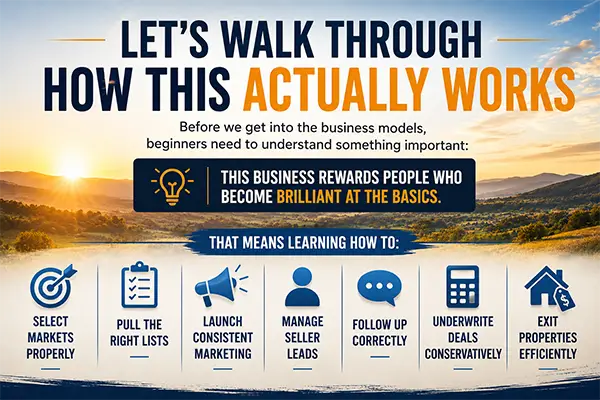
Before we get into the business models, beginners need to understand something important: this business rewards people who become brilliant at the basics.
That means learning how to:
Select markets properly
Pull the right lists
Launch consistent marketing
Manage seller leads
Follow up correctly
Underwrite deals conservatively
Exit properties efficiently
The people who fail are usually trying to shortcut one of those steps.
A beginner today honestly has a huge advantage because the tools and systems available are far better than when most of us started.
For market selection and list pulling, I recommend MyLandPortal because it simplifies a process that used to require stitching together multiple systems and datasets.
For direct mail and marketing campaigns, Land Boss Marketing helps beginners launch campaigns without getting buried in operational setup.
For lead management and seller follow-up, a CRM like Lead Boss CRM matters because land deals are rarely made on the first conversation. Consistency wins this business.
And honestly, beginners need structure more than motivation.
That is why I built Land Flipping Mastery as a self-paced course for people who want to learn the mechanics at their own speed, while Land Boss Group Coaching is designed for investors who want live support, live deal reviews, help with market selection, list pulling, and actually getting campaigns launched correctly.
Because most beginners do not fail from lack of information.
They fail from inconsistency, confusion, and making avoidable mistakes early.
Small Deals Teach You the Business Fast
Small land deals are usually where people start, and honestly, that makes sense.
The risk is lower. The mistakes are cheaper. You can learn how sellers think, how buyers respond, how title works, how agents perform, and how long land actually takes to move.
That education matters.
A small deal can teach you more than ten hours of YouTube videos. You start seeing the patterns that actually drive buyer behavior.
Can I get to it?
Can I build on it?
Can I camp on it?
Can I put a manufactured home on it?
Is there power nearby?
Why is it so cheap?
Those simple buyer questions reveal what actually matters in land.
Not theory. Not spreadsheets. Utility.
Small deals are valuable because they give you reps. More seller conversations. More buyer conversations. More listings. More closings. More opportunities to make mistakes without getting destroyed financially.
That builds experience quickly.
The problem is that many Land Flippers accidentally stay there forever.
At first, making $3,000 or $5,000 on a deal feels incredible. And it should. It validates the business model. But eventually you realize the math starts working against you if you want to scale meaningfully.
If every deal only makes a few thousand dollars, you need a lot of deals.
That means more marketing, more leads, more follow-up, more seller conversations, more qualifying properties, more listings, more closings, and more operational weight overall.
The business starts becoming less about land and more about managing activity.
Small Deals Always Work But Competition and Demand Change
One mistake I see newer Land Flippers make is assuming small deals “stopped working” when markets shift.
That is usually not true.
Small deals are almost always available somewhere.
What changes is competition and buyer demand.
When buyer demand is strong and inventory is low, cheaper lots can move quickly. You can turn inventory fast and keep capital moving.
But when inventory starts piling up and buyers slow down, things change fast.
If your entire business depends on high volume, and suddenly there is far more inventory than buyer demand, properties can start sitting much longer than expected.
That is when people become what I call dirt rich, cash poor.
They own a lot of land. On paper they may have decent equity. But their cash gets trapped inside slow-moving inventory.
That creates pressure.
Taxes still exist. Marketing still exists. Overhead still exists. Sellers still need callbacks. Team payroll still needs to happen.
Meanwhile the land sits.
This is why adaptability matters so much in land flipping.
People talk about “the market” like it is one giant national machine, but real estate is often extremely local.
One county can feel completely dead while another area is absolutely white hot.
I have seen markets where properties barely moved while another state was moving inventory almost as fast as we could list it.
The investors who survive long term are usually the ones willing to adapt.
Sometimes that means changing pricing strategy.
Sometimes it means changing acquisition strategy.
Sometimes it means switching markets entirely.
The people who struggle the most are usually the ones emotionally attached to one county or one system that used to work.

More Small Deals Usually Means More Team and More Management
A high-volume small-deal business can absolutely work.
But people need to understand what they are actually building.
Most volume-focused land businesses are really marketing businesses first.
They are driven by lead generation and operational throughput.
That means consistent mail, cold calling, texting campaigns, lead management, intake systems, follow-up systems, property review systems, listing systems, and transaction coordination.
That is a real business.
And real businesses usually require people.
For most cheaper-lot businesses, those teams are often Philippines-based virtual assistants working in roughly the four-to-six-dollar-per-hour range.
The labor is inexpensive relative to U.S. employees, but that does not mean it is effortless.
You still have to recruit people.
Train people.
Manage people.
Replace people.
Build systems.
Monitor quality control.
Track lead flow.
Review acquisitions.
Handle seller escalations.
And maintain consistency when people inevitably make mistakes.
At a certain point, some investors realize they do not actually want to own a marketing business.
They do not want to manage intake.
They do not want to oversee large VA teams.
They do not want to manage high lead volume every day.
They simply want to do good land deals.
That realization matters because it often changes the ideal business model entirely.
Bigger Deals Require Better Judgment, But Less Volume
The fewer-big-deals model is a completely different approach.
Instead of doing dozens of smaller transactions, you may only do one to three meaningful deals per year.
That sounds crazy to some people until they realize one strong deal can outperform an entire year of smaller flips.
But bigger deals expose weak thinking fast.
Small mistakes become expensive mistakes.
If you misprice a $10,000 parcel by 20% that is only $2,000, you can often recover. If you misjudge a more expensive property, let's say a $200,000 property by 20%, that's $40,000 and that can hurt badly.
That is why bigger deals require stronger underwriting and better judgment.
You need to understand:
Buyer profile.
Access.
Terrain.
Utilities.
Floodplain, Wetlands.
Zoning.
Demand.
Days on market.
Exit strategy.
Liquidity.
You cannot hide behind “I bought it cheap.”
Cheap alone does not create a good deal.
The best larger deals usually have multiple advantages working together. Maybe there is subdivide potential. Maybe there is strong builder demand nearby. Maybe inventory is tight. Maybe the seller values flexibility more than price.
That is where experience matters.
Data narrows the range of the properties and area you target. Judgment sets the price.
The good news is that bigger-deal businesses often require far less operational chaos.
You may spend more time analyzing fewer opportunities, but you are not necessarily managing hundreds of leads and dozens of active transactions. In fact, larger deals do not always require heavy off-market marketing. Sometimes when MLS inventory gets bloated and sellers start sitting, you can buy an on-market property at 70–80% of its listed price, then create additional value through a subdivision or improved exit strategy and dramatically increase the property’s value. Bigger deals often become less about running massive marketing campaigns and more about recognizing mispricing, structuring the deal correctly, and managing the project intelligently.
In many cases, you become more of a project manager and capital allocator than a marketer.
Some people are much better suited for that model.
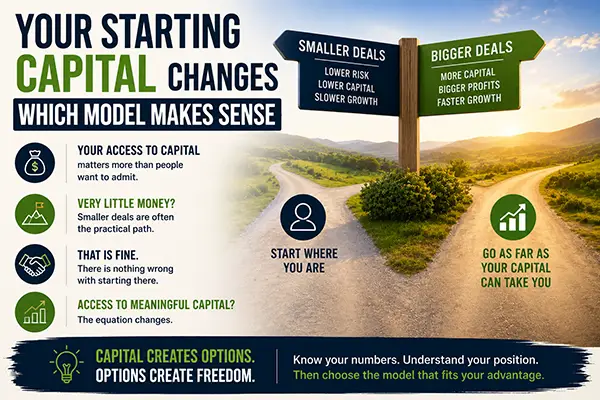
Your Starting Capital Changes Which Model Makes Sense
Your access to capital matters more than people want to admit.
If someone enters land flipping with very little money, smaller deals are often the practical path.
That is fine. There is nothing wrong with starting there.
But if someone enters the business already having access to meaningful capital, the equation changes.
Maybe they have a HELOC on their house.
Maybe they can use a self-directed IRA.
Maybe they can take a 401(k) loan.
Maybe they have life insurance cash value.
Maybe they already have strong liquidity.
Or maybe they just have piles of money sitting in a vault they are only using to backstroke through like Scrooge McDuck.
Either way, if a Land Boss student of mine comes into the business with access to $150,000–$250,000+ in capital, I usually steer them toward fewer, larger deals instead of trying to build a massive high-volume machine around cheap lots. That is especially true in my 1-on-1 coaching, because I can act as a second set of eyes on the deal and help sherpa them through the transaction—from market selection and underwriting to negotiation, structure, and exit strategy.
Why?
Because they do not necessarily need the operational complexity.
They can afford to be selective.
They can afford stronger due diligence.
They can use agents and title companies comfortably.
They can structure deals creatively.
And most importantly, they can focus on maximizing quality instead of maximizing transaction count.
That is a very different business.
My Preference: Learn With Smaller Deals, Then Move Up Carefully
I like smaller deals for learning.
I do not like being trapped there permanently.
Small deals are great teachers. They build instincts quickly. They teach you what buyers care about and how sellers behave.
But eventually I believe most serious Land Flippers should move toward better deals, not just more deals.
That transition should happen carefully.
You do not jump from $5,000 parcels to giant speculative projects overnight because you got bored.
You earn the right to do larger deals by improving your market selection, pricing, underwriting, negotiation, and exit planning.
The progression matters.
Small deals give you reps.
Bigger deals require standards.
And over time, the best investors usually become more selective, not less.
They stop chasing activity and start protecting capital velocity.
Because ultimately, this business is not about owning the most land.
It is about controlling risk, keeping capital moving, and buying properties with clear exits and strong downside protection.
More small deals can work.
Fewer big deals can work.
But the right model depends on your capital, your personality, your skill set, your time, and the kind of business you actually want to operate.
The mistake is assuming there is only one way to build a successful land business.
There is not.
The investors who last the longest are usually the ones who stay flexible enough to adjust when the market changes instead of forcing one model to work forever.
Land Flipping FAQs
What software do beginners need to start land flipping?
Most beginners need three things:
A way to select markets and pull lists
A way to market consistently
A way to manage and follow up with leads
For market selection and list pulling, I recommend MyLandPortal.
For direct mail and marketing campaigns, use Land Boss Marketing.
For seller lead management, follow-up and lead conversion use Lead Boss CRM.
What is the best way for beginners to learn land flipping?
If you want a self-paced option where you can learn the business fundamentals step-by-step, start with Land Flipping Mastery.
If you want live coaching, live deal reviews, help selecting markets, pulling lists, launching campaigns, and getting questions answered directly, then Land Boss Group Coaching is the better fit.
What if I do not have enough money to start?
A lot of beginners underestimate how important access to capital is in this business.
If you need funding for software, lists, marketing campaigns, or operational setup, Land Boss Credit helps investors access 0% business credit cards.
If you already have a deal under contract and need acquisition funding, Land Boss Funding can help fund deals.


