

How Land Flipping on eBay Actually Works
Most people never think about eBay when they think about land investing.
They think about Zillow.
They think about Land.com.
Maybe county tax auctions.
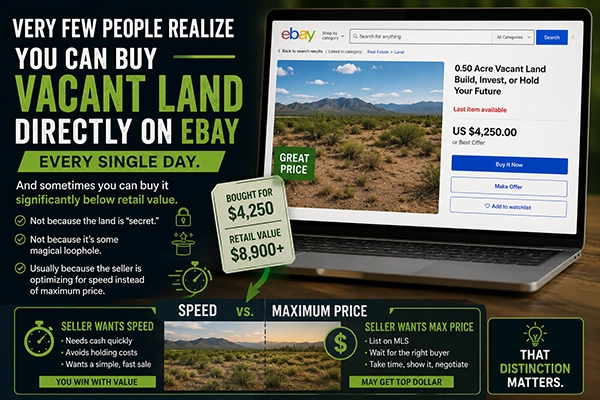
But very few people realize you can buy vacant land directly on eBay every single day.
And sometimes you can buy it significantly below retail value.
Not because the land is “secret.”
Not because it’s some magical loophole.
Usually because the seller is optimizing for speed instead of maximum price.
That distinction matters.
Some sellers are liquidating inherited property.
Some bought large portfolios and need quick turnover.
Some are volume operators moving inventory fast.
And many of them market the property terribly.
That creates opportunity.
One thing I noticed early when reviewing eBay land listings was how weak most of the marketing was.
Blurry screenshots.
Generic descriptions.
No real property photos.
No explanation of what the land can actually be used for.
Sometimes the seller hasn’t even visited the property.
That matters because land is emotional.
People buy based on what they can picture themselves doing there.
Camping.
Building a cabin.
Parking an RV.
Escaping the city.
Owning something tangible.
If the listing does not help the buyer visualize the property, demand drops.
That’s where a lot of beginners misunderstand land flipping.
They think the entire business is about finding hidden deals.
Sometimes the opportunity is simply better marketing.
I’ve literally split-screened eBay on one monitor and Land.com on another and seen nearly identical properties listed for dramatically different prices.
Same county.
Similar acreage.
Similar access.
Completely different presentation quality.
That pricing gap is often the opportunity.
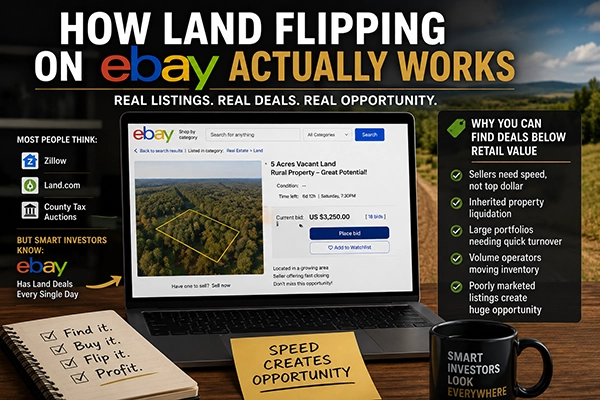
Why eBay Works for Land Flipping
A lot of the sellers on eBay are not true retail marketers.
They are inventory movers.
That’s an important difference.
Some are liquidating bulk properties.
Some are auction buyers reselling inventory quickly.
Some inherited the land and just want it gone.
That creates inefficiencies.
And land flipping is fundamentally a business built around inefficiencies.
You are identifying situations where:
The property is under-marketed
The seller wants speed over optimization
The presentation is weak
The buyer pool is limited
The property is being sold below realistic retail value
Not every listing is a deal.
Far from it.
A lot are overpriced.
A lot have major issues.
A lot are unusable parcels with access or terrain problems.
But every once in a while you’ll find a property where the seller simply did a poor job presenting it.
That’s where disciplined buyers can create value.
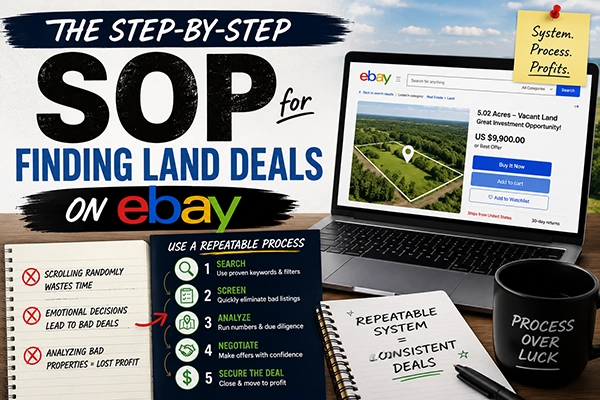
The Step-by-Step SOP for Finding Land Deals on eBay
The biggest mistake beginners make is approaching eBay randomly.
They scroll listings emotionally and waste hours analyzing bad properties.
You need a repeatable process instead.
Step 1: Navigate to eBay Land Listings
Go to eBay and navigate to:
Shop by Category
All Categories
Real Estate
Land
Once inside the land category, you’ll usually find hundreds of active listings.
Your goal is not to analyze every property.
Your goal is to systematically filter for opportunity.
Step 2: Export Listings Into a Spreadsheet
Instead of manually reviewing listings one at a time, export the data into a spreadsheet.
I recommend using Chrome extensions like:
Instant Data Scraper
Table Capture
Export the listings into CSV format and upload them into Google Sheets or Excel.
From there, organize the properties into a working spreadsheet.
Step 3: Build a Property Evaluation Sheet
Create columns for:
Parcel ID
County and State
Acreage
Asking Price
Estimated Retail Value
Access Notes
Flood Zone Status
Terrain Notes
Wetlands Status
Maximum Bid Price
The purpose is to quickly identify which properties deserve deeper analysis and which should immediately be discarded.
Step 4: Run Comparable Sales Analysis
Next, determine realistic retail value.
Not what the seller hopes the property is worth.
Actual market value.
This is where I personally use Land Portal.
One reason I like Land Portal is because it allows me to evaluate multiple parts of the deal quickly in one place.
I use the AI Comp Report feature to estimate realistic value ranges based on comparable properties.
That helps me quickly identify:
Potentially underpriced listings
Overpriced properties
Reasonable resale ranges
Whether a property deserves further analysis
I still verify comps manually.
I still use judgment.
But the AI Comp Report with Land Portal dramatically speeds up the valuation process.
Step 5: Verify Physical and Legal Access
Once a property passes the comp review, the next step is access verification.
Inside Land Portal, I evaluate:
Physical access
Legal access
Road frontage
Ease of entry
Whether roads appear maintained
This is critical.
A property can look excellent in listing photos and still be nearly unusable because of access problems.
I’ve seen parcels where legal access technically existed on paper but the road was practically impossible to use.
Access problems destroy marketability.
That’s why I verify this early.
Step 6: Review Flood Zones, Wetlands, and Terrain
Next, I evaluate the physical usability of the property.
Inside Land Portal, I typically review:
Flood Zone layers
Wetlands layers
Slope and contour views
Terrain and elevation data
3D property views
Google Street View integration
This step alone eliminates a huge percentage of bad deals.
I’ve seen:
Parcels advertised as buildable that sat almost entirely inside wetlands
Properties that appeared flat but were actually steep once contours were reviewed
Rural parcels with severe flooding issues hidden by listing photos
Cheap land is not automatically good land.
Step 7: Contact the Seller
If the property still looks promising, contact the seller directly through eBay.
Ask simple questions like:
Have you visited the property?
Is there confirmed legal access?
Are utilities nearby?
Are there HOA fees?
Has a perc test been completed?
Why are you selling?
You’ll quickly determine whether the seller actually understands the property or is simply liquidating inventory.
Sometimes the best opportunities come from sellers who just want speed and simplicity.
Step 8: Determine Your Maximum Purchase Price
Before bidding, determine your maximum purchase price.
Do not bid emotionally.
Do not assume appreciation will save the deal.
Your numbers should account for:
Estimated resale value
Closing costs
Marketing costs
Holding time
Desired profit margin
Downside risk
Your profit is usually made on the buy side.
Step 9: Improve the Property Presentation
This is where a lot of the actual value creation happens.
Many eBay land listings suffer from terrible presentation.
That’s why the deal exists in the first place.
Once you purchase the property, improve the marketing significantly.
That usually means:
Getting real on-site photos
Ordering drone footage
Creating better maps
Writing stronger property descriptions
Explaining the property’s actual utility
Offering seller financing if appropriate
A property with professional presentation often dramatically outperforms a poorly marketed listing, even when the land itself is nearly identical.
Step 10: Re-List the Property on Better Platforms
Once the property is properly marketed, re-list it on stronger retail platforms.
I typically recommend:
Craigslist
Facebook Marketplace
Zillow (For Sale By Owner)
This is one reason many eBay flips work in the first place.
A lot of sellers on eBay simply have weak marketing and limited exposure.
When you combine:
Better photos
Better descriptions
Better maps
Better financing terms
Better platform exposure
…the exact same property can suddenly become much more desirable to retail buyers.
That pricing gap is often where the profit exists.
The Biggest Mistakes Beginners Make
Most beginner mistakes are predictable.
The first mistake is buying land simply because it looks cheap.
Cheap does not equal good.
There’s a reason some parcels are nearly worthless.
No access.
Bad terrain.
Floodplain issues.
No buyer demand.
Tiny unusable lots.
You need to understand why the property is discounted.
The second mistake is skipping due diligence.
This is where beginners usually get hurt.
Photos can hide problems.
Descriptions can leave out major issues.
You need to verify what you are actually buying.
Not what you hope you are buying.
The third mistake is poor marketing after acquisition.
This is ironic because improving marketing is often the entire opportunity.
If you relist the property with the same weak presentation, you probably will not create much value.
The fourth mistake is overbuying.
Land feels inexpensive.
That causes people to accumulate too much slow inventory.
Ten slow parcels are not diversification.
They are distractions.
I care far more about capital velocity than collecting random properties.
Final Thoughts
eBay land flipping works because markets are inefficient.
Some sellers prioritize speed over optimization.
Some market properties terribly.
Some buyers fail to do proper due diligence.
And some investors create value simply by presenting land more professionally than the previous owner.
That’s the business.
Not hype.
Not magic.
Not hidden tricks.
Clear thinking.
Good judgment.
Conservative buying.
Strong marketing.
And consistency.
If you approach eBay land deals with discipline and proper due diligence, there are legitimate opportunities there.
But the opportunity is not in blindly buying cheap land.
The opportunity is in understanding why the property is underpriced and whether you can realistically improve the exit.
That’s the difference between gambling and operating.
Land Flipping FAQs
Can you actually buy and flip land on eBay?
Yes. There are hundreds of active vacant land listings on eBay at any given time. Many sellers are liquidating inventory quickly and prioritizing speed over price which creates real buying opportunities for disciplined investors.
Why is land on eBay sometimes cheaper than retail value?
Most eBay land sellers are inventory movers, not retail marketers. They often have weak photos, poor descriptions, and limited platform exposure which reduces buyer demand and drives prices down below what the property could realistically sell for elsewhere.
How do I know if an eBay land listing is actually a good deal?
Run comparable sales in the same zip code, verify legal and physical access, check flood zones and wetlands, and make sure there is actual buyer demand in the area. Cheap price alone never makes a deal worth buying.
What do I do after buying land on eBay?
Improve the presentation dramatically better photos, drone footage, stronger descriptions, boundary maps, and seller financing if applicable. Then relist on stronger retail platforms like Land.com, Zillow, or the MLS where buyer demand and pricing expectations are higher.
What is the biggest mistake beginners make with eBay land flipping?
Buying based on price alone. Cheap land on eBay is often cheap for a reason no access, wetlands, bad terrain, or zero buyer demand in the area. Your job is to understand why it's discounted before deciding whether the opportunity is real.


