
How to Buy Land at Tax Auctions for Profit: Beginner Guide
How to Buy Land at Online Tax Auctions and Flip for Profit: A Beginner's Guide
Most people think land flipping only works one way.
They picture someone sending direct mail, buying cheap off-market land, then reselling it for more.
That’s absolutely one way to do it.
But it’s not the only way.
One of the biggest misconceptions beginners have is thinking there’s some single “correct” path into the land business. The reality is there are multiple ways to source deals and multiple ways to create value. One of the most overlooked opportunities for beginners is buying land through online tax auctions.
The reason I like online tax auctions for beginners is because you can literally sit at your computer and browse live inventory across the country. You don’t need a real estate license. You don’t need a huge marketing budget. You don’t need to wait 6 months for direct mail campaigns to start producing leads.
You can go online today and start researching actual parcels that counties are auctioning off right now.
That’s actually how I got started.

The Online Tax Auction Flip
Most counties eventually auction off properties when property taxes go unpaid long enough.
Years ago these auctions happened mostly on courthouse steps.
Today, many counties conduct them online.
That means investors all over the country can bid remotely without ever physically attending an auction.
Some investors build entire businesses around buying tax auction land.
But there’s also a lot of junk at these auctions.
That’s where beginners get into trouble.
They see a parcel selling for $800 and immediately think:
“Wow… this must be worth $20,000.”
Maybe.
Or maybe it’s completely unusable.
Cheap land does not automatically mean good land.
A cheap unusable property is still unusable.
That’s why your job is not just finding “cheap” land.
Your job is finding land that other people actually want to buy.
That’s a massive difference.
Step-by-Step Process for Finding Tax Auction Properties on Bid4Assets
One of the easiest places to start learning online tax auctions is: Bid4Assets
Now to be clear:
Bid4Assets is not the auction platform for all 50 states. Different counties use different auction systems. But it’s one of the best beginner-friendly sites for learning how online tax sales work and seeing real inventory available online.
Step 1: Go to Bid4Assets
Open the homepage.
Step 2: Locate “County Tax Sales”
On the left-hand side of the homepage you’ll see a section labeled:
“Specialty Channels”
Under that section click:
“County Tax Sales”
Step 3: Browse Upcoming Auctions
You’ll now see upcoming auctions from different counties around the country.
Click into an auction that interests you.
Step 4: Download the Property List
Once inside the auction page:
Scroll down
Locate the section labeled “Auction Folders”
Expand the section
Click the orange button labeled:
“Click Here to Download Property List Spreadsheet”
Step 5: Upload the Spreadsheet
Open the spreadsheet inside:
Google Sheets
Microsoft Excel
Airtable
Or whatever spreadsheet software you prefer
Now you can start reviewing the properties one by one.
Your Job Is NOT to Find Cheap Land
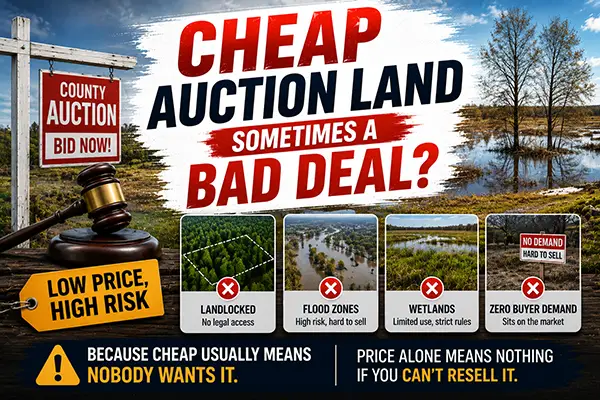
This is the part beginners misunderstand.
You are not looking for the cheapest property.
You are looking for the best combination of:
Liquidity
Demand
Usability
Low competition
Margin potential
The biggest mistake beginners make is buying land simply because it’s inexpensive.
I’ve seen people buy:
Landlocked parcels
Flooded parcels
Tiny unusable remnants
Steep mountain cliffs
Properties with no legal access
Wetlands
Parcels nobody wants
The property may technically be “cheap”…
…but if nobody wants it, you still lose.
Research the Property Before You Bid
Once you identify a parcel you’re interested in, you need to start researching it.
This is where most of the real work happens.
You should be checking things like:
Does the property have legal access?
Is it landlocked?
Is the terrain usable?
Is there road frontage?
Is it in a flood zone?
Are there wetlands?
Is there power nearby?
Is there actual buyer demand in that area?
One of the easiest methods for beginners is to use Land Portal to research each parcel individually by copying the APN (Assessor Parcel Number) from the spreadsheet and searching it inside the Land Portal interactive map. From there, you can turn on layers like wetlands and flood zones, check the slope and topography of the property, and visually verify both legal and physical road access. This allows you to quickly eliminate unusable properties before you ever place a bid. Once you’ve narrowed the list down to properties that actually make the cut, you can then go onto websites like:
…and searching for similar vacant land within the same zip code to start researching what like kind property is selling for and how quickly.
Check the Inventory Before You Buy
This is one of the most important lessons in land flipping:
You don’t make money when you buy cheap.
You make money when you can resell quickly.
A parcel may look like a “deal” until you realize there are 900 similar parcels sitting unsold in that same area.
That’s a problem.
Before buying any auction property, search the zip code on Land.com or Zillow and study:
How many similar properties are currently listed?
How long have they been sitting?
Are there actual sold comps?
Are properties actively moving?
Is inventory stacking up?
Is the area oversaturated?
If you see huge amounts of stale inventory and very few sold properties, that’s a warning sign.
This is why I focus heavily on liquidity and market velocity.
I would personally rather own a slightly smaller margin deal in a fast-moving market than a massive “potential spread” in an area where nothing sells.
Use Land Portal’s Drill Deep Feature
This is where tools like Land Portal become extremely powerful.
Inside Land Portal you can use the Drill Deep feature to analyze the market metrics of properties similar to your subject parcel.
You can evaluate metrics like:
Sell Through Rate (STR)
Days on Market (DOM)
Months of Supply (MOS)
You can analyze these metrics over:
The last 6 months
The last 12 months
And most importantly:
You can analyze them within the exact acreage range and zip code of your subject property.
That matters.
Because a 1-acre parcel market may behave completely differently than a 40-acre parcel market within the same county.
This is one of the reasons I prefer zip-code level analysis instead of broad county analysis.
Some zip codes inside a county are extremely liquid.
Others are completely dead.
The numbers tell the story.
Sell Through Rate (STR)
Sell Through Rate helps you understand how quickly inventory is actually selling.
If there are 100 active listings and 100 sold listings over a certain timeframe, that’s a very strong market.
If there are 500 active listings and only 20 sold listings, that’s a weak market.
Days on Market (DOM)
Days on Market tells you how long properties are sitting before selling.
Generally speaking:
Lower DOM = stronger demand
Higher DOM = slower market
Months of Supply (MOS)
Months of Supply measures how long it would take for current inventory to sell based on the current sales pace.
This metric is extremely important.
High months of supply usually means inventory is stacking faster than buyers are absorbing it.
That’s dangerous if you’re trying to flip quickly.
Understand Title Before You Bid
This is another major area beginners overlook.
Not all auction properties come with immediately marketable title.
Sometimes the county auction gives you marketable title right away.
Other times there may be a redemption period, quiet title requirement, or waiting period before you can obtain title insurance.
You need to understand this before bidding.
Usually you can contact the county treasurer’s department directly and ask questions like:
Does the property come with marketable title?
Is there a redemption period?
Can the property be immediately title insured?
Is there a waiting period before resale?
Do not assume.
Always ask.
What If the Property Doesn’t Have Marketable Title?
This is where companies like:
can become extremely valuable.
Companies like TTS help qualify tax deed properties for title insurance by working with underwriters and title partners.
That can allow you to:
Resell the property with marketable title
Obtain title insurance
Refinance through traditional lending
Increase buyer confidence dramatically
A lot of beginners think a tax deed property is automatically unsellable if title is messy.
That’s not necessarily true.
But you absolutely need to understand the title situation before you buy.
Start Small
One of the smartest things you can do as a beginner is start small and controlled.
Don’t try to buy a giant acreage deal on Day 1.
Don’t empty your savings account chasing a “huge spread.”
Your first goal is not maximizing profit.
Your first goal is learning the process safely.
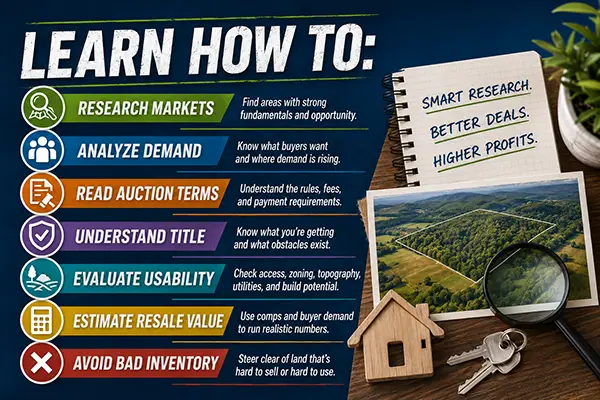
Learn how to:
Research markets
Analyze demand
Read auction terms
Understand title
Evaluate usability
Estimate resale value
Avoid bad inventory
That experience compounds fast.
Over time you’ll get better at spotting opportunities and avoiding traps.
And eventually you’ll realize something important:
The people consistently making money in land flipping usually are not the people buying the cheapest land.
They’re the people buying the most liquid land.
Land Flipping FAQs
Are online land auctions legitimate?
Yes. Counties across the country legally auction off tax-delinquent properties online. Platforms like Bid4Assets host real county auctions with actual inventory you can research and bid on from anywhere.
Why is cheap auction land sometimes a bad deal?
Because cheap usually means nobody wants it. Landlocked parcels, flood zones, wetlands, and areas with zero buyer demand show up at auctions constantly. Price alone means nothing if you can't resell it.
Do I need a lot of money to buy land at auction?
No. Some parcels sell for a few hundred dollars. The bigger concern isn't the purchase price — it's making sure you understand the title situation and resale market before you bid.
What is a redemption period and why does it matter?
Some states give the original owner a window of time to reclaim the property after the auction by paying back taxes. If a redemption period exists, you may not be able to resell immediately. Always confirm with the county before bidding.
How do I know if there's actual demand for a property I find at auction?
Search the zip code on Land.com or Zillow and look at how many similar properties are listed, how long they've been sitting, and whether there are recent sold comps. If inventory is stacking with no sales activity, move on.


