

How to Contact Motivated Land Sellers
Most people misunderstand what they’re actually doing when they market to landowners.
They think they’re trying to find motivated sellers.
They’re not.
They’re putting themselves in position so that when motivation shows up, they’re already in front of it.
That sounds like a small distinction, but it changes everything about how you approach this business.
Because once you understand that, you stop trying to be perfect-and you start building a system that consistently produces deals.
There are two primary ways to find motivated sellers. I call them Probability Marketing and Propensity Marketing.
You won't find those terms in a marketing textbook. They're concepts I coined to describe two fundamentally different approaches to finding deals. Once you understand the difference, you'll start to see why some investors consistently uncover opportunities while others struggle to gain traction.
Let's begin with the first approach: Probability Marketing. Before we get there, however, it's important to understand the status quo. Most investors are taught to market a certain way, and for good reason-it works. But it also has limitations. Once we cover the traditional approach, I'll show you how Probability Marketing takes a different path.
Status Quo; You’re Not Finding Motivation - You’re Letting It Reveal Itself
When you pull a list of off-market landowners from the assessor roll and start marketing to them, you’re not exclusively targeting “motivated sellers.”
You’re targeting potential.
Then you let reality sort the list for you.
Some people will ignore you.
Some will tell you no.
A small percentage will raise their hand and say, “Yeah, I’ve actually been thinking about selling.”
That’s the business.
What you’re really doing is creating a filter where:
Your outreach goes out wide
Motivation comes back narrow
That’s why the statement matters:
You position yourself so that when motivation shows up, you’re already in front of them.
If you understand this, you stop expecting every list to perform.
And you start focusing on building consistent exposure.
Why Most Investors Stay Stuck at the Top of the Funnel
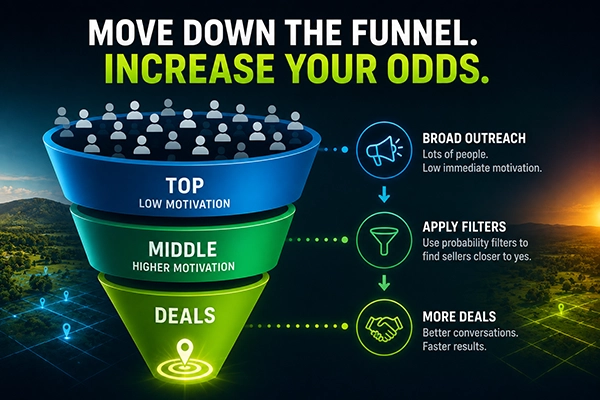
If all you do is pull a general list of vacant landowners and market to them, you’re operating at the very top of the funnel.
That’s not wrong. It works.
But it’s slow.
Because you’re dealing with:
Low immediate motivation
Long timelines
A lot of noise
You’re waiting for motivation to develop.
That’s why beginners feel like nothing is happening. It is happening-it’s just happening slowly and invisibly.
What experienced operators do differently is simple:
They don’t just rely on broad outreach.
They use filters that increase the odds that someone is already closer to selling.
That’s how you move from the top of the funnel toward the middle-where conversations turn into deals much faster.
The First “Sneaky Trick”: Probability Filters
This is where things start to get more precise.
Instead of pulling every landowner, you start pulling probable sellers.
Not guaranteed sellers. Just more likely.
This comes from pattern recognition over time.
I’ve been marketing to landowners since 2014, and after a couple years, the patterns become obvious.
Certain types of owners consistently respond more than others.
1. Absentee Ownership
This is the baseline.
Now, you might be thinking, "If we're targeting vacant land, aren't all owners absentee owners?" Technically, yes. But not all absentee owners are created equal. The farther an owner lives from their property, the more likely they often are to view it as a nonessential asset, and that can have a meaningful impact on response and acceptance rates.
You want owners who don’t live near the property.
Out-of-county is good
Out-of-state is even better
Distance creates detachment.
Detached owners are more likely to sell because:
They don’t use the property
They don’t have emotional attachment
Managing it is inconvenient
This alone improves your list quality significantly.
Now, to be completely transparent, I've done some incredible deals with owners who lived in the very same county as the property. So we don't want to get carried away with filters and accidentally outsmart ourselves. That said, those deals have been the exception rather than the rule.
Without conducting a formal audit of every transaction I've completed, I'd estimate that roughly 80% of my deals have come from out-of-county owners and about 20% from owners who lived in the same county as the land. While that's not a scientific study, it does illustrate an important point: if one group has historically produced the vast majority of your deals, it probably deserves the majority of your marketing attention.
2. Length of Ownership (The “Tired Owner” Effect)
This is one of the most consistent patterns I’ve seen.
Target people who have owned the land for 15+ years.
These are what I call “tired landowners.”
Think about their situation:
They bought the land with a plan (usually to build)
Life happened
The plan never materialized
They’ve been paying taxes every year
At some point, the property stops feeling like an asset and starts feeling like a burden-or, at the very least, a dormant asset that isn't serving any meaningful purpose in the owner's life.
That’s where motivation quietly builds over time.
These sellers don’t always look motivated-but they’re much closer than someone who bought the land last year.
3. Individual Owners vs Corporate Owners
Focus on individuals.
“John Smith”
Not “John Smith Enterprises LLC”
Corporate owners can sell-and many deals come from them-but they’re typically more calculated, more sophisticated and more current with the pulse of the market.
They’re not emotionally fatigued.
They’re not dealing with life friction.
When you’re building probability lists, you want people, not entities.
Because people make emotional decisions.
What Probability Actually Does
Probability doesn’t guarantee a deal.
It just improves your odds.
Instead of marketing to 10,000 random landowners, you’re marketing to 1,000 landowners who are statistically more likely to sell.
That’s a big difference over time.
But there’s a limit.
Even with strong probability filters, you’re still mostly dealing with people who might sell someday.
You’re still at the top of the funnel-just a better version of it.
If you're wondering how I pull these lists, I use MyLandPortal.com. Not every land data platform offers these filtering capabilities, but it's the exact software I use to build my Probability Marketing lists.
The Second “Sneaky Trick”: Propensity Lists
This is where things change fast.
If probability is about likelihood, propensity is about immediacy.
Propensity means someone is in a situation that makes selling more likely right now.
This is how you effectively “teleport” from the top of the funnel to the middle.
Because now you’re not waiting for motivation.
You’re stepping into it.
Examples of High-Propensity Situations
These are some of the most powerful lists you can pull:
Pre-foreclosures
Foreclosures
Tax-delinquent properties
Death of a joint tenant
Probate
Bankruptcy
HOA liens
Property liens
Expired listings
Every one of these represents a situation.
And situations create urgency.
Why Propensity Beats Probability
A tired landowner might sell eventually.
A tax-delinquent owner might need to sell soon.
That’s the difference.
Probability: More likely than average
Propensity: More likely right now
When you market to propensity lists, you’re dealing with people whose backs are closer to the wall.
That doesn’t mean you take advantage of them.
It means you’re offering a solution when they actually need one.
That’s why these lists convert faster.
The Trade-Off
Propensity lists are more competitive.
More investors understand their value.
And most importantly-they’re more efficient.
You don’t need as much volume when the timing is right.
But they’re still underutilized compared to generic lists.
Why, because most land flippers have little to no idea where to pull these specialized propensity lists because most known “land” data products don’t have the ability to leverage these niche lists.
Now, I could keep these data sources locked away in a secret vault and pretend they're too valuable to share. But in the spirit of helping fellow land investors, I'm going to show you exactly where I get them. Full disclosure, however: I'm generous, but I'm not a saint - these are affiliate links.
1). PropertyRadar
2). Propstream
How to Actually Reach These Potential Sellers
Once you have the right lists, the next question is simple:
How do you contact them?
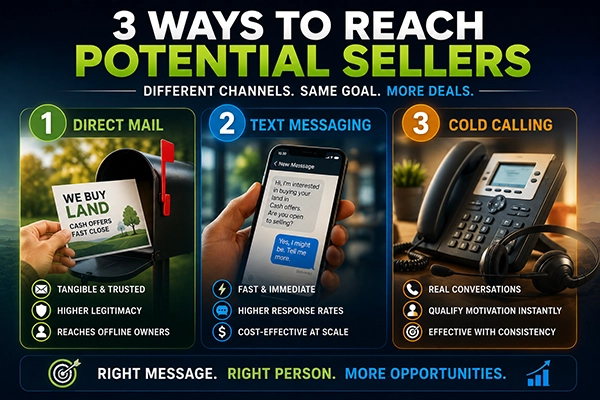
There are three primary channels that consistently work.
1. Direct Mail
This is still the foundation.
Simple, scalable, and proven.
You send a letter or postcard expressing interest-or a direct offer with an offer amount.
It works because:
It’s tangible
It feels legitimate
It reaches people who ignore or don’t participate in digital channels
For example, many landowners, let's say… aged 75 and older tend to trust, prefer, and respond more favorably to this marketing channel.
2. Text Messaging
Faster, cheaper and more immediate.
You can reach someone directly on their mobile phone.
Response rates can be significantly higher-but so is the need to handle conversations and disqualify sellers quickly.
Platforms like Launch Control or Lead Boss CRM make this manageable at scale.
Text messaging can be an incredibly effective marketing channel, but it also comes with legal and compliance considerations.
If you don't understand the rules, you can create unnecessary problems for yourself. At a minimum, you'll want to scrub your lists against Do Not Call (DNC) registries, known litigators, and other compliance-related databases before launching a campaign.
If that sounds intimidating—or if you'd simply rather focus on finding deals than managing compliance—you can outsource the entire process. A done-for-you marketing company can handle the setup, compliance, messaging, and execution while qualified leads are delivered directly into your CRM.
If you'd like to explore that option, check out LandBossMarketing.com to learn more about our exclusive discounted texting packages for land flippers.
3. Cold Calling
Direct and effective.
You’re having real conversations.
You can qualify motivation instantly.
Tools with built-in dialers-like PropertyRadar-make this easier to manage.
But cold calling requires skill and consistency.
It’s not about scripts. It’s about being comfortable having simple conversations.
Done-For-You Options
If you don’t have the time-or don’t want to deal with compliance-there are vendors who handle texting and cold calling for you.
That’s a leverage decision.
Not a requirement.
If that is something that sounds appealing to you and you want to explore that option, check out LandBossMarketing.com to learn more about our exclusive discounted cold calling & texting packages for land flippers.
Why Channel Matters Less Than Consistency
People get stuck trying to pick the “best” channel.
There isn’t one.
What matters is:
You pick a channel
You use it consistently
You follow up
That’s where results come from.
Not from switching tools every month.
What Actually Converts a Seller
At this point, you’ve:
Pulled better lists
Reached out consistently
Started conversations
Now what?
Here’s the part most people miss:
Sellers don’t convert because of your marketing.
They convert because your offer solves their problem.
That usually means:
A simple process
Clear communication
Minimal friction
Confidence the deal will actually close
Price matters, but it isn't the only factor.
I've seen sellers accept lower offers simply because the process felt easier and more certain. Sometimes they wanted a two-week closing instead of the typical four-week timeline. In other cases, they wanted more than we were willing to pay in cash, so we structured a higher purchase price with a small down payment and monthly installments.
We've also worked with landowners who owned landlocked property and struggled to find buyers. Often, the strongest opportunities come from propensity leads people dealing with an immediate situation such as tax delinquency, probate, divorce, or another life event that creates a stronger motivation to sell.
That happens more often than people expect.
The Real Advantage: Staying in the Game Longer
Most investors quit too early.
They:
Send one campaign
Get weak results
Move on
Meanwhile, the seller they contacted becomes motivated three months later-and sells to someone else.
This business truly rewards consistency more than intelligence.
If you keep showing up:
With probability lists
With propensity lists
With consistent outreach
With clear offers
You start to see deal flow stabilize.
Not overnight.
But predictably.
A Simple Way to Think About This
If you want to simplify everything:
Broad lists = exposure
Probability lists = better odds
Propensity lists = better timing
Then you layer:
Consistent outreach
Clear offers
Follow-up
That’s the entire system.
Final Thought
There’s no secret list that guarantees deals.
But there are smarter ways to build lists.
Most people stay stuck blasting generic data and hoping something sticks.
Experienced operators tighten the inputs:
They improve probability
They prioritize propensity
They stay consistent with outreach
And over time, that compounds.
You don’t need to chase motivated sellers.
If you build the system correctly, you’ll be in front of them when it matters-and that’s what actually gets deals done.
Land Flipping FAQs
How do I find motivated land sellers?
You don't find them you position yourself in front of them consistently. Pull better lists, reach out through direct mail, text, or cold calling, and follow up long after everyone else stopped. Motivation often shows up months after the first contact.
Which marketing channel works best for reaching landowners?
There is no single best channel. Direct mail, text messaging, and cold calling all work. What matters far more than which channel you pick is whether you use it consistently and follow up repeatedly over time.
What makes a propensity list better than a regular landowner list?
A regular list targets people who might sell someday. A propensity list targets people in situations that create a reason to sell now tax delinquency, probate, foreclosure, or liens. Less volume needed and faster conversions because the timing is already working in your favor.
Why do sellers sometimes accept lower offers?
Because price is not always the most important factor. A simple process, clear communication, confidence the deal will close, and minimal friction can matter more than the highest number. Some sellers will take less just to have certainty and speed.


