

How to Find Land Flipping Deals (Step-by-Step Guide)
How to Find Land Flipping Deals (Step-by-Step Guide)
Most people think finding land deals is about luck-stumbling across a cheap property and flipping it for a profit.
That’s not how this actually works.
Land flipping is a process. If you remove the randomness and build a repeatable system, deals stop feeling rare and start showing up consistently. The difference between someone who does one deal and someone who builds a real business usually comes down to this: they stop “looking” for deals and start generating them.
This guide walks through that process step by step the way it actually plays out in the real world.
The Real Problem: Why Most People Never Find Deals
Before getting into steps, it’s worth addressing what usually goes wrong.
Most beginners start in the wrong place. They browse listings on the MLS. They scroll marketplaces. They wait for something to “look like a deal.”
That approach puts you at the very end of the pipeline where competition is highest and margins are thin.
Land flipping doesn’t work because you find obvious deals. It works because you create opportunities before they become obvious.
The shift is simple:
You’re not shopping for land.
You’re sourcing motivated sellers.
Once you understand that, everything else in this process starts to make sense.
Step 1: Choose a Market Where Land Actually Sells
This is where most beginners quietly sabotage themselves.
They chase cheap land instead of active markets.
Cheap land doesn’t automatically mean opportunity. A lot of times, it just means there’s little to no demand.
What you’re really looking for is a market where land is consistently moving.
Here’s how I think about it in practice:
If land sits for months with no activity, I don’t care how cheap it is
If listings are consistently selling, I pay attention
If there’s a steady flow of both new listings and sold listings, that’s a healthy market
You can sanity-check this with a few simple signals:
Are there recent sold listings?
Are new listings appearing regularly?
Does inventory actually move?
I’ve seen people buy “great deals” in dead markets and get stuck holding them for years. On paper, it looked smart. In reality, it tied up capital, slowed momentum, and killed cash flow.
A smaller active market beats a large stagnant one every time.
For market selection, I personally use MyLandPortal.com.
Land Portal lets you analyze metrics like population growth, sell-through rate, days on market, and inventory movement so you can actually interrogate a market instead of guessing. You can also view these metrics across different time intervals, but personally, I prefer looking at the last 6 months because I believe it gives the clearest read on the current pulse of a market.
If you have no idea where to start, a simple shortcut is filtering for states with 2% or greater population growth over the last year. That one filter alone can take you from staring at a map of all 50 states down to a much smaller list of viable markets.
From there, you can drill down at the county or ZIP-code level and filter out areas that don’t meet your criteria.
Personally, I’m looking for markets where properties are consistently selling within 6 months or less.
I teach this process step-by-step live inside my Land Boss Group Coaching 8-week training program, and I also break down the full framework inside my Land Flipping Mastery course where I show exactly how I research and select markets before I ever spend a dollar on marketing.
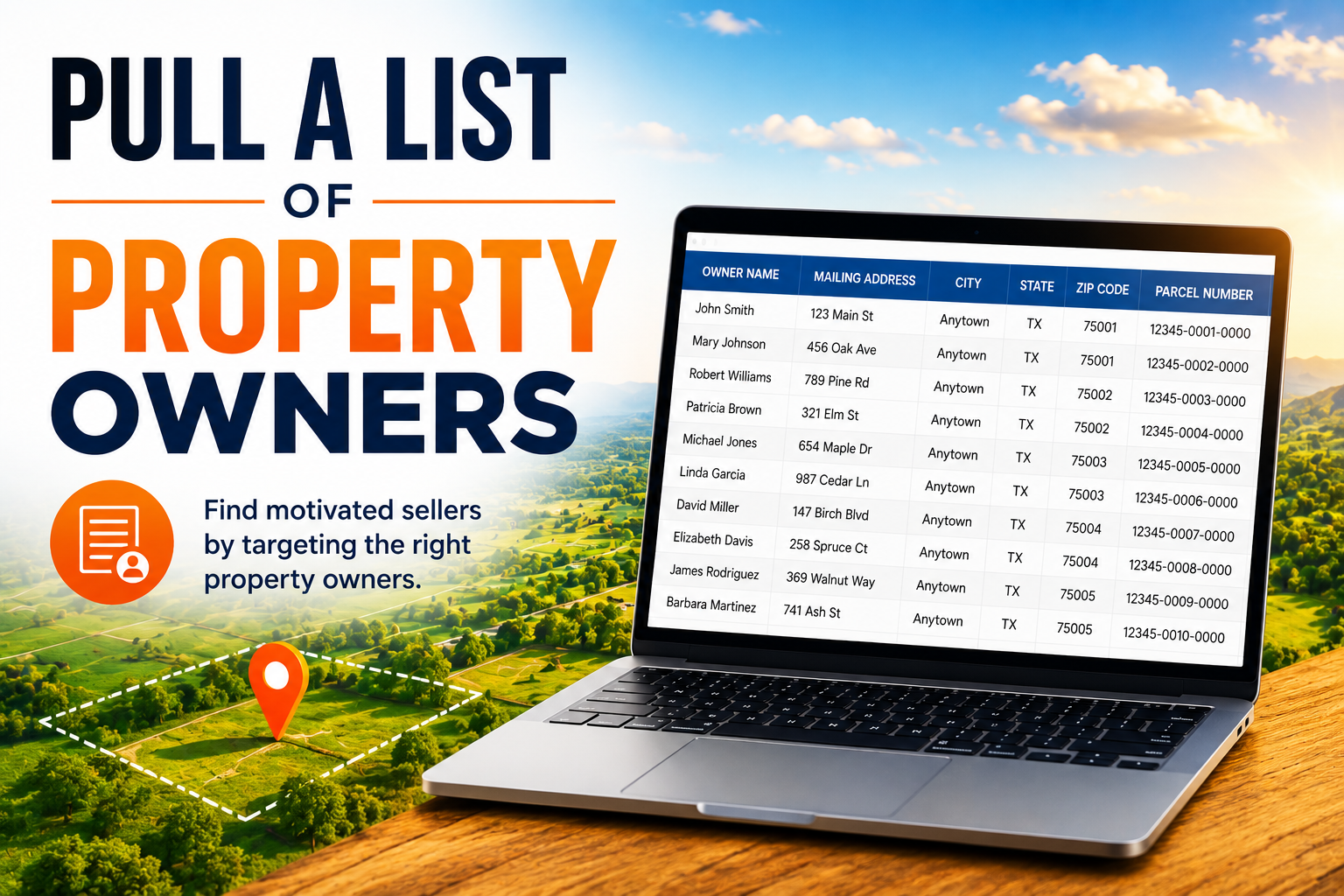
Step 2: Pull a List of Property Owners
Once you’ve picked a market, the next step is building a list of people to contact.
This is where the business actually starts.
What MyLandPortal.com allows us to do is target specific properties that meet our criteria not necessarily specific owners with known motivation. That’s an important distinction.
What we do know is that we’re building a list of properties that are more likely to fit our buy box or resale criteria. What we don’t know yet is which owners are motivated to sell.
That’s why this is a numbers game.
The goal is simple: build a list of landowners in your chosen market and reach out to them directly.
Now, there are certain filters that can increase the probability of finding sellers who may be more open to selling.
Not guarantees just higher probability.
Some common filters that work well are:
Out-of-state owners
Long-term ownership (10–15+ years)
Vacant land with no recent activity
Older ownership records with little engagement
These aren’t magic triggers. They’re simply indicators.
You’re stacking the odds slightly in your favor before you ever send your first text, mail piece, or cold call.
And this part matters more than people realize. A better list doesn’t just improve response rates it reduces wasted marketing dollars, wasted conversations, and wasted time.
Some educators teach students to only target certain acreage ranges, like parcels over 5 acres. Personally, I don’t approach it that way.
I don’t really care whether I’m flipping a half-acre infill lot or a 40-acre rural parcel.
What I care about is value.
That’s why I often use something broad like 0.5 to 50 acres and instead focus heavily on estimated resale value.
One of the powerful features inside Land Portal is the ability to filter by minimum and maximum LP Estimated Value. This lets you leverage their AI valuation system to target properties that fit your desired resale range.
For example, if I only want properties that I believe can realistically resell between $50,000 and $150,000, I can filter specifically for that range. That prevents my list from getting filled with properties outside my buy box and keeps my marketing focused on deals that actually fit my business model.
There are plenty of additional filters and considerations too:
Do you target corporate-owned land or avoid it?
How much wetland is acceptable?
How much slope is acceptable?
Do you avoid flood zones?
Do you only target road frontage properties?
One of the biggest advantages of Land Portal is being able to scrub out bad properties on the front end before you ever buy or download the list.
That alone can save you thousands in wasted marketing.
Step 3: Price the Land Using Real Comps
This is where beginners either overcomplicate things or get it completely wrong.
You’re not trying to find the “perfect” value.
When pulling a list, you’re trying to establish a realistic value range that meets your criteria
Here’s how it actually works:
Use the LP Estimate Price filter and input a value in the minimum price and in the maximum price
For clarification most the time we aren’t sending out marketing with actual offers. My preference if you want to go that route is that you draw a polygon on the land portal map at the subdivision level and hyper-target or what I call land sniping subdivisions where all lots have similar values. Those are the type of campaigns I run where I actually send offers blindly or blind offers.
In the example I will be talking about sending out letters of interest, text messages of interest then manually and accurately estimating value before extending an offer, ensuring we are making accurate, intelligent offers.
When the lead responds to our marketing we can look at live comps in addition to pulling a comp report from Land Poral.
This is the key you don’t offer market value.
You offer a fraction of it.
Typically, in lower price ranges, offers land somewhere around:
15% to 35% of market value
That’s where your margin comes from.
This isn’t about being aggressive for the sake of it. It’s about building in room for:
Selling costs
Holding time
Mistakes
Because mistakes will happen.
I’ve seen people try to be precise down to the dollar. That’s not how this works. Land pricing is not that exact.
Data narrows the range. Judgment sets the price.
Step 4: Send Direct Offers (This Is Where Deals Come From)
This is the step most people hesitate on and it’s also where almost all deals originate.
You need to reach out to property owners.
Not once. Not casually. Consistently.
There are a few ways to do it:
Direct mail
Text messaging
Cold calling
The specific channel matters less than consistency.
What matters is this:
You are initiating the conversation.
You are not waiting for sellers to come to you.
In land flipping, outreach drives everything.
Here’s what that looks like in reality:
You send hundreds or preferably thousands of offers
95% or more of the people on your marketing list don’t respond
Of those a small percentage are actually motivated and willing to sell at a discounted price
That’s normal.
Silence is not rejection it’s just part of the process.
This is where I’ve seen the biggest disconnect.
People expect immediate responses. They send 50 offers, hear nothing, and assume it doesn’t work.
Meanwhile, the people actually doing deals are sending thousands and following up for months.
So how do you market to these landowners?
Once your list is built in Land Portal or any other platform you pull a list from, you can export it and begin marketing.
Personally, I recommend skip tracing the list upon export with Land Portal because I believe the best results usually come from using multiple marketing channels together - not relying on just one.
Most of my students run a done-for-you cold calling and texting campaign through Land Boss Marketing or send SMS campaigns from Lead Boss CRM while also mailing direct mail campaigns at the same time.
Direct mail campaigns can be sent through Lead Boss CRM or directly through Land Portal itself.
Step 5: Become a BOSS at Follow-Up!
If you take one thing from this guide, let it be this:
The deal almost never happens on the first contact.
Sellers need time.
Situations change.
Motivation builds gradually.
What that looks like in the real world:
Someone who says “not interested” today may sell six months from now
Someone who ignores your first message may respond to your third follow-up
Someone sitting on the fence may finally act once life forces a decision
I’ve personally closed more deals from follow-up than from the initial outreach.
Not because the first contact failed.
Because the timing wasn’t right yet.
This is where consistency becomes your advantage.
A lot of land investors are marketing to the same counties and often pulling from many of the same property owner lists. What separates people long term isn’t just the list — it’s the follow-up.
Remember, that spreadsheet you exported isn’t just rows of data. There are real people on the other side of it, and life changes constantly.
-Some people lose jobs.
-Some get divorced.
-Some inherit property.
-Some relocate for work.
-Some owners pass away.
-Some finally decide they’re tired of paying taxes on land they never use.
A hard “no” today can absolutely become a “yes” later if their situation changes.
I still buy land in some of the same Northern Arizona counties like Coconino County and Yavapai County that I started marketing to back in 2014.
Most people quit marketing too early.
They don’t give themselves enough volume, enough time, or a large enough sample size before chasing the next shiny object crypto, Airbnb, AI day trading, whatever’s trending that month.
I’m not telling you to spend recklessly on marketing forever.
I’m telling you to stay consistent long enough to give yourself a real chance to win.
Because in this business, the people who stick around and follow up usually beat the people constantly starting over.
Step 6: Evaluate Deals Using Simple Filters
Once responses start coming in, you don’t chase every lead.
You filter quickly.
You’re not trying to find reasons to force a deal to work you’re trying to eliminate obvious problems before they become expensive mistakes.
I’m not going to do a deep dive into the full property qualification and disqualification process here because I have an entire module dedicated to it inside my Land Flipping Mastery Course, along with a 2-hour live training inside the Land BOSS Group Coaching program covering my FASTER CHOICE framework, which has become widely used throughout the land investing community.
https://travisking.com/programs
For this guide, I just want to give you a surface-level understanding of how I quickly evaluate properties.
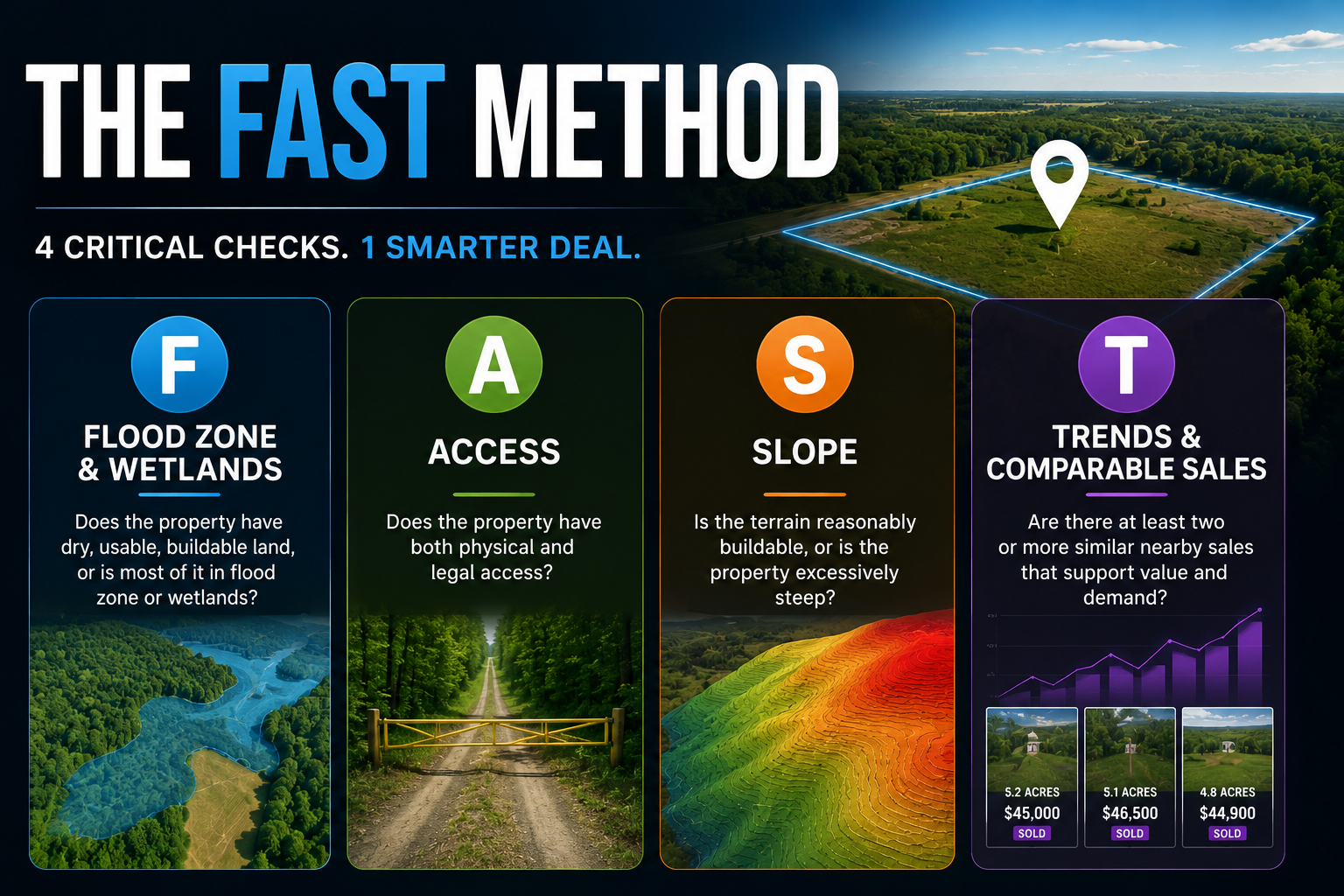
I use something I call the FAST Method.
Here’s the simplified version:
F = Flood Zone & Wetlands
Does the property actually have dry, usable, buildable land, or is most of it covered in flood zone or wetlands?
A = Access
Does the property have both physical and legal access?
S = Slope
Is the terrain reasonably buildable, or is the property excessively steep?
T = Trends & Comparable Sales
Are there at least two or more similar nearby sales that support value and demand?
If something feels off, slow down.
If multiple things feel off, walk away.
One pattern I’ve seen repeatedly is beginners trying to “make deals work.”
Experienced operators do the opposite.
They disqualify deals quickly.
That mindset alone can save you massive amounts of time, money, and frustration.
Step 7: Structure the Deal Based on What Actually Works
This is where most guides oversimplify things.
Not every deal should be a cash purchase.
Sometimes the numbers don’t work at your target price.
That doesn’t mean the deal is dead.
It means you look at structure.
Options include:
Cash purchase at a lower price
Seller financing (payments instead of full upfront cash)
Option agreements
Double closing with a buyer lined up
Flexibility is an edge in this business.
I’ve seen plenty of deals where price alone didn’t solve the seller’s problem but terms did.
A lot of sellers aren’t necessarily looking for the absolute highest cash offer. They want certainty, simplicity, convenience, speed, or a structure that fits their personal situation.
For example, I once spoke with a seller in his 80s who told me he preferred not to sell for one lump sum because he was receiving SSI (Supplemental Security Income) and was concerned a large cash payout could create issues with his benefits. His preference was to spread the payments out over 10 years instead.
Now, I’m not an attorney, CPA, or benefits expert, and I’m certainly not qualified to advise someone on SSI regulations. But that conversation stuck with me because it reinforced an important lesson:
Sometimes the best deal structure isn’t purely about price it’s about flexibility.
If you’re willing to think creatively during acquisition conversations, you can uncover opportunities the “I only pay cash and close fast” crowd completely misses.
That flexibility can become a real competitive advantage.
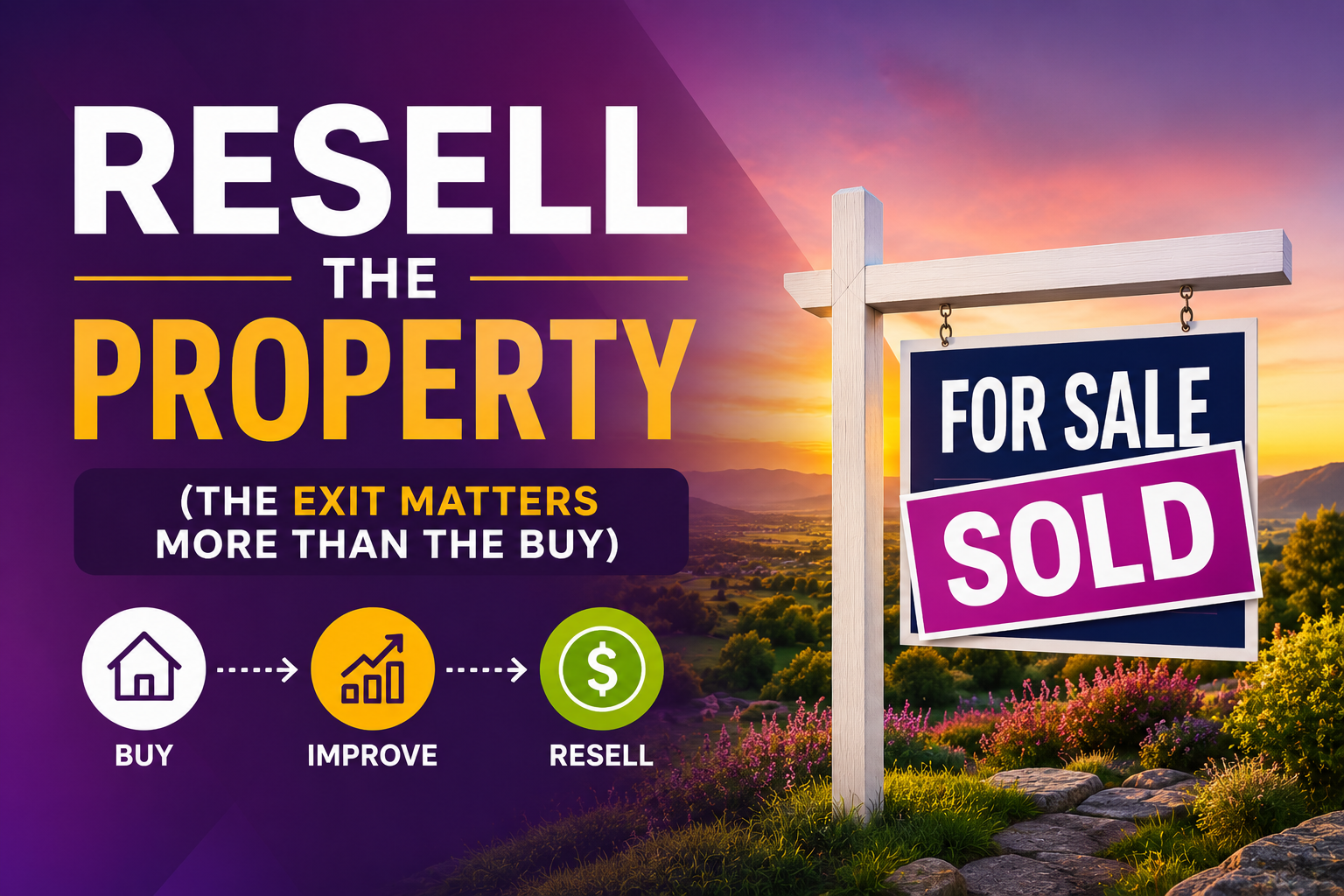
Step 8: Resell the Property (The Exit Matters More Than the Buy)
Most beginners obsess over buying cheap.
That’s only half the equation.
The real test is whether you can actually sell the property.
Before you ever close on a deal, you should already have a rough answer to questions like:
Who is the likely buyer?
How will I market the property?
Is this more suited for a cash buyer or a payment buyer?
Is there enough demand in this area to create velocity?
If you don’t know how the property is likely to sell, that’s a problem.
This is where market selection comes back into play again.
In a strong market:
Properties move
Buyers exist
Pricing is more predictable
Demand creates liquidity
In a weak market:
Listings sit
Buyers are scarce
Pricing becomes guesswork
Deals can get stuck for months or years
I’ve seen plenty of deals that looked amazing on paper fall apart simply because the exit strategy wasn’t clear.
You don’t get paid when you buy land.
You get paid when it sells.
That’s why, when we initially select markets, we’re really starting with the end in mind the resale. That’s also why we focus so heavily on disposition metrics like Sell Through Rate, Days on Market, and Months of Supply during market selection. Those metrics help stack the odds in your favor before you ever send your first marketing campaign.
Now when it comes time to resell the property, you have a decision to make:
Do you list it with an agent, or do you sell it yourself?
In my own business, my preference is to focus on properties worth roughly $40,000 to $50,000 or more, and I almost always use agents to resell them. But that’s a model I evolved into over time.
A lot of newer land flippers especially those targeting lower-priced properties will list properties themselves on platforms like Land.com, Facebook Marketplace, or Craigslist as “For Sale By Owner.”
There’s nothing wrong with that approach.
Personally, I prefer using agents because I believe MLS exposure generally commands stronger pricing, attracts more qualified buyers, and often results in larger down payments when seller financing is involved. I also don’t particularly enjoy spending my time messaging and fielding calls from tire-kicker buyer leads.
Either way, the important thing is this:
You have to market the property if you want it to sell.
And just like when you bought the property, once you find a buyer you’ll typically open escrow again with a title company. The buyer wires funds into escrow, documents are signed, and once the transaction closes, the title company disburses your proceeds by wire or check.
And hopefully?
You don’t hold onto that check very long.
Because now you’re a land flipper.
And land flippers love velocity.
Common Mistakes That Slow People Down
After watching this play out repeatedly, the same mistakes keep showing up.
1. Treating This Like Deal Hunting
Waiting for deals instead of generating them.
2. Choosing Cheap Markets Instead of Active Ones
Confusing low price with opportunity.
3. Sending Too Few Offers
Expecting results from minimal effort.
4. Not Following Up
Walking away too early.
5. Overanalyzing Pricing
Trying to be exact instead of reasonable.
6. Ignoring the Exit
Buying without a clear path to selling.
None of these are complicated problems.
They’re decision problems.
Land Flipping FAQs
How do I find motivated land sellers?
You don't find them you generate them. Build a targeted list of landowners in an active market, reach out directly through mail, text, or cold calls, and follow up consistently. Most deals come from the third or fourth contact, not the first.
How many offers do I need to send to get a deal?
More than most beginners expect. A typical campaign might get responses from 5% or less of your list, and only a fraction of those will be motivated enough to sell at a discount. Volume and follow-up are what separate people who do one deal from people who build a real business.
Do I need to find deals off-market or can I buy on the MLS?
Both work. Off-market deals through direct mail and texting campaigns typically offer better margins. But in today's market, on-market properties are sitting longer and sellers are cutting prices meaning you can sometimes buy MLS listings at 20% or more below asking if you know what to look for.


