

How to Find Off-Market Land Deals by going Direct to Seller
One of the fastest ways to find land deals isn’t waiting for properties to hit the MLS it’s going directly to landowners before the property is ever listed for sale. That’s what real estate investors refer to as “direct-to-seller” or “off-market” marketing. Instead of competing against dozens of buyers on publicly listed properties, you proactively reach out to owners of vacant land and ask if they would consider selling. The reality is most people won’t respond, some will ignore you completely, and a few may even get annoyed by the outreach. But a small percentage will be motivated enough to sell and those opportunities can turn into highly profitable land deals. In this article, I’m going to walk you through the exact process I personally use to identify strong land markets, build targeted marketing lists, and start sourcing off-market land deals directly from owners.
Direct to Seller (Off-Market)
Below, I’ll walk you through step-by-step how to quickly and repeatably identify strong land markets without wasting countless hours researching dead areas with little demand.
You’ll need to sign up for Land Portal if you don’t already have access. If you sign up using my affiliate link >>here<<, you’ll receive 1,500 free records along with two bonus mini courses:
Turning Landlocked Lots into Liquid Gold
The Bullseye Method: ZIP Code Investing
Now let’s get started.
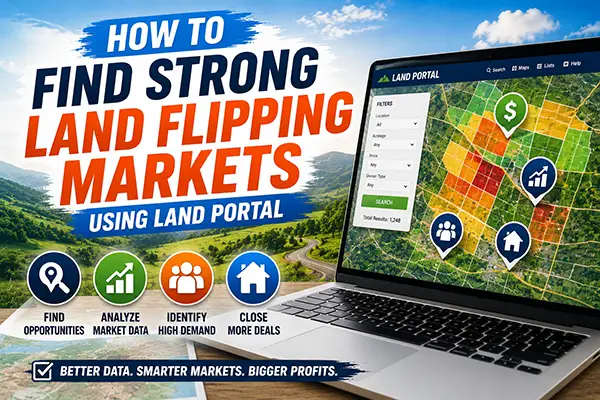
SOP: How to Find Strong Land Markets Using Land Portal
Step 1: Open the Market Research Tool
After logging into Land Portal:
Click “Market Research” on the left-hand menu
Select “Drill Deep” from the top horizontal menu
At this point, you’ll see a high-level overview of states and market data.
How to Identify States With Strong Demand
If you already have a state in mind, great.
If not, here’s a simple way to narrow down states with population growth and transactional activity.
Step 1: Open Filters
Click the “Filters” button in the top-left corner.
Step 2: Set Population Growth Filter
Locate the Population Growth field and enter:
Minimum: 2%
This helps identify states where people are actively moving.
Population growth matters because growing populations typically create more housing demand, development demand, and land demand.
Step 3: Set Transaction Volume Filter
Locate the Count field and enter:
Minimum: 500
The Count field represents the number of sold comps in the last 12 months.
This is important because you do not want to operate in markets with almost no transactional activity.
As a general rule, if you’re remotely investing in a state, I prefer seeing at least 500 sold land transactions annually.
Step 4: Apply Filters
Click “Apply.”
You’ll now be left with a much smaller list of states where:
Population growth is occurring
Land is actively trading
Demand likely exists
Think of this exercise as your compass. You’re trying to identify states where movement and momentum already exist.
How to Compare ZIP Codes Across an Entire State
Once you’ve selected a state, the next step is drilling deeper into individual ZIP codes.
Personally, I prefer comparing ZIP codes directly against each other instead of analyzing counties one by one.
Step 1: Enable ZIP Code View
In the top-right corner of the screen:
Select “Only Zips”
This bypasses the normal State → County hierarchy and allows you to compare ZIP codes across the entire state at once.
Step 2: Filter to Your Desired State
Click “Filters”
Locate the State field
Enter your target state
Click “Apply”
Once applied, click anywhere on the state row to expand it and reveal all ZIP codes within that state.

How to Analyze Today’s Market Conditions
By default, Land Portal uses a 12-month timeframe.
I prefer analyzing the last 6 months because it gives a much better read on what’s happening in today’s market.
Step 1: Change the Timeframe
At the top of the screen:
Locate the Time dropdown
Change it from 1 Year to 6 Months
Now you’re analyzing much more recent market activity.
ZIP Code Filters I Personally Use
Next, click the “Filters” button above the ZIP code table.
These filters are somewhat subjective, but below are the ones I commonly use when searching for strong land markets.
Recommended ZIP Code Filters
Median Price: $25,000 – $500,000
Comp Count: Greater than 10
Days on Market: Less than 240
Sell Through Rate: Greater than 75%
Population Growth: Greater than 2.2%
Months of Supply: Less than 10
After entering the filters, click “Apply.”
You should now be left with a relatively short list of ZIP codes that show:
Strong demand
Consistent transactional activity
Reasonable liquidity
Faster resale velocity
If your list becomes too small, loosen the filters slightly.
For example:
Increase maximum Days on Market
Lower Sell Through Rate slightly
Increase Months of Supply slightly
Market selection is always a balancing act between quality and opportunity volume.
SOP: Building Your Marketing List
Once you’ve identified promising ZIP codes, the next step is generating a marketing list.
Step 1: Open List Building
Navigate to the List Building section inside Land Portal.
Step 2: Input Your Target Criteria
At minimum, input:
Your selected ZIP codes
Desired acreage ranges
Estimated minimum value
Estimated maximum value
Step 3: Export Your List
Once your filters are configured:
Export the list
Prepare it for marketing
At this point, you officially have a targeted landowner list.
This article could easily turn into a thick user manual if I covered every possible list-building filter and strategy, so I’ll stop here for the sake of keeping this beginner-friendly.
I go much deeper into list building, filtering, pricing strategy, and marketing workflows inside my Land Flipping Mastery self-paced course and my Land Boss Group Coaching Program.
Now the Real Game Starts
Once you have a list, you can begin marketing.
Most land flippers will either:
Send direct mail
Cold call
Send text messages
Email
Or combine multiple channels together
You can import your list into Lead Boss CRM and manage your outreach campaigns there, or you can hire done-for-you vendors that specialize in cold calling and text messaging for land investors. If you’re interested in going that route you can check Land Boss Marketing for exclusive done for you texting and cold-calling packages.
At this point, you’re no longer “learning” land flipping.
You’re actually in the business.
Now the game becomes:
Generating leads
Talking to sellers
Making offers
Negotiating deals
And learning how to identify opportunities faster than your competition.
Land Flipping FAQs
What does off-market mean in land flipping?
It means the property isn't listed for sale anywhere publicly. You're reaching out directly to landowners before they've ever considered listing which means less competition and more room to negotiate a discount.
How do I know which markets to target for off-market deals?
Look for areas with consistent land sales, population growth, and fast resale velocity. If land isn't moving in a market, it doesn't matter how good your list is or how much you spend on marketing.
How many people on my list will actually respond?
Most won't. A response rate of 5% or less is normal. That's not a failure it's just how the numbers work. Volume and consistent follow-up are what turn a list into real deals.
What's the best way to contact off-market landowners?
Most investors use a combination of direct mail, cold calling, and text messaging together. Using multiple channels at once almost always outperforms relying on just one.
Do I need a big budget to start marketing directly to sellers?
Not necessarily. Start with a smaller targeted list in one ZIP code rather than blasting a massive campaign. A focused list in an active market will outperform a large list in a weak one every time.


