

How to Make Money Flipping Land Without Experience
Most people start land flipping the wrong way.
They jump straight into tactics-mailers, pricing, tools-without ever deciding what kind of business they’re actually trying to build.
That’s why they get stuck.
Before you worry about how to flip land, you need to decide how you want to participate in the business. Because there isn’t just one way to make money here-and each path requires a different approach.
If you skip this step, you’ll build something that doesn’t fit your time, your capital, or your goals. And eventually, you’ll quit.
Let’s fix that first.

The First Decision: What Role Are You Actually Playing?
Before you get into tactics, you need to decide how you want to participate in this business.
There are dozens of ways to make money with land.
But early on, too many options can create confusion-not clarity.
So instead of trying to see everything at once, focus on a few clear on-ramps.
There are countless ways to break into land investing, but five paths rise above the rest. They aren't the only routes to success, but for most aspiring land investors, they're the most practical, proven, and accessible places to start.
1. The Operator (Active Land Flipping Business)
This is the full business.
You’re generating leads, talking to sellers, pricing deals, and managing dispositions. You’re building a repeatable machine.
This is where scale lives-but it also requires the most time and consistency.
2. The Side Hustler (1–3 Deals Per Year)
You’re not trying to build a business. You just want a few solid deals each year.
Less volume. Less pressure. Still real money.
This is where a lot of people should start-but don’t admit it.
3. The Assignment Investor (The Deal Finder)
This is one of the fastest ways to get paid in this business.
You find deals, get properties under contract, and then assign that contract to another investor, builder, or end buyer.
You don’t actually close on the property.
You control the deal, pass it off, and collect an assignment fee.
This is fast cash-but it usually requires more transactions to hit bigger income goals unless you focus on larger, higher-value deals.
I’ve seen people burn out here doing small assignments over and over. And I’ve also seen people do fewer deals, but target larger properties and still hit meaningful income without high volume or a big team.
The path works-but you need to be intentional about deal size.
4. The Project Player (1 Larger Subdivide Per Year)
Instead of small flips, you focus on one higher-dollar deal.
You buy a larger parcel, improve it (often by subdividing), and create value before selling.
Fewer deals. Bigger decisions. More complexity.
5. The Deal Funder (Capital Partner)
You don’t find deals.
You fund them.
You partner with operators who bring opportunities, and you structure deals where your capital earns a return.
This is the most hands-off-but requires trust, deal flow, and disciplined underwriting.
Reality Check: Does Your Time and Money Match Your Choice?
Once you pick a path, you need to pressure-test it.
Most people don’t do this. They pick based on excitement, not reality.
Start with time.
Be honest about how much you actually have-not what you wish you had.
If you have 20+ hours per week, running an active operation is realistic. If you only have a few hours here and there, you’re going to struggle trying to act like a full-time operator.
Then look at your money situation.
You don’t need a lot to start-but your path still needs to match your resources.
Low capital pushes you toward active roles like operator or assignment investor. More capital opens up larger projects or funding deals.
If your time and money don’t align with your chosen path, adjust now.
I’ve seen people try to force a business model that doesn’t fit their life. It always breaks.
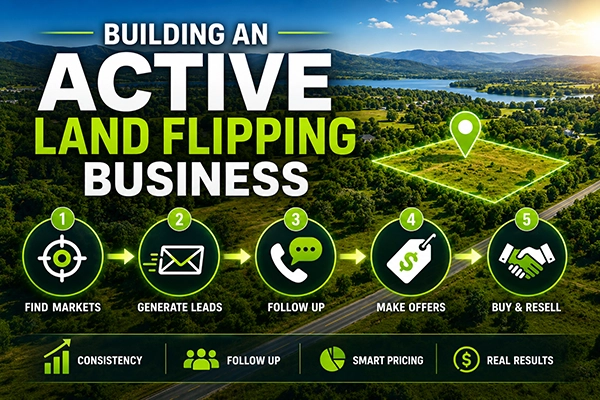
Path 1: Building an Active Land Flipping Business
If you choose to be an operator, you’re not chasing deals-you’re building a system.
The business is simple in structure:
You find markets where land sells quickly, generate leads, buy at a discount, and resell at market value.
The challenge is consistency.
Market selection comes first. You’re not looking for cheap land-you’re looking for land that actually moves. If properties sit for months with no buyers, it doesn’t matter how inexpensive they are.
Then comes lead generation. This is where deals actually start. Direct mail, cold calls, text outreach-it doesn’t matter which method you use. What matters is doing it consistently.
Most people quit here because they expect immediate results.
They send a batch of outreach, get little response, and assume it doesn’t work or they generate some leads but due to being new in the business they struggle with lead conversion so they assume this land thing doesn’t work.
That’s a mistake.
Most sellers aren't ready to sell when you first contact them—but they may be ready later. That's why some of the best deals come from consistent follow-up, not the initial conversation.
A small percentage of sellers will accept your offer on the first contact, but they are the exception, not the rule. You can improve your odds by targeting out-of-state owners and long-term holders, but no matter how good your marketing is, you'll hear far more "no's" than "yes's" in this business.
That's not a flaw in the process—it's simply the nature of the game.
Pricing is where this becomes real.
You’re not trying to be perfect-you’re trying to be realistic. Data and comps gives you a range, not an exact number. Judgment is what turns that range into an offer that still leaves room for profit.
If you approach this like a repeatable process instead of a one-off opportunity, it works.
Path 2: Doing a Few Deals Per Year on the Side
This path doesn’t get talked about enough.
Probably because it’s not flashy.
But for a lot of people, this is the right entry point.
You’re not trying to build a full business. You’re just looking to do a handful of deals each year and generate meaningful extra income.
The key here is focus.
You don’t need multiple markets. You don’t need complex strategies. You need one or two areas where land sells, and enough outreach to create a few opportunities.
You also have an advantage most full-time operators don’t.
You can be patient.
You don’t need to force deals. You can wait for situations where the numbers clearly work.
I’ve seen people make solid five-figure income annually doing this without turning it into a full-time commitment.
The mistake is trying to operate like a full-time business when you don’t have the time for it.
Path 3: Making Money as an Assignment Investor
This path is about speed and deal flow.
You’re not holding property. You’re not tying up capital long-term.
You’re finding deals, getting them under contract, and passing them to someone else for a fee.
That means your skillset shifts.
You need to get good at:
Finding motivated sellers
Pricing deals so there’s room for another buyer
Building a network of buyers who trust you
If you don’t have buyers, you don’t have a business here.
The biggest mistake I see is people locking up deals without a clear exit.
That creates stress fast.
The cleanest version of this path is when you already know who would buy the deal before you even put it under contract.
This is where speed comes from.
If you stay in lower-priced deals, you’ll need volume to hit meaningful income.
If you move into higher-value properties, you can do fewer deals-but each one matters more.
Path 4: One Larger Subdivide Project Per Year
This is a different approach entirely.
Instead of flipping small parcels, you’re focusing on creating value.
You might buy a larger property and split it into smaller lots. Or improve it in a way that increases its usability and demand.
The upside is bigger-but so is the margin for error.
At this level, property details matter more than ever. Access, zoning, terrain, utilities-these aren’t minor considerations. They determine whether the deal works at all.
You also need to think about the exit before you buy.
Who is the end buyer?
If you don’t know that clearly, you’re guessing. And guessing with larger deals is expensive.
Timelines also stretch here. Permits, approvals, improvements-everything takes longer than expected.
This path works well for people who have more capital and are comfortable making fewer, more calculated decisions.
Path 5: Being the Deal Funder
This is the cleanest path on paper.
You’re not sourcing deals. You’re funding them.
But this doesn’t mean it’s passive in the way most people think.
You’re evaluating deals-and more importantly, the people bringing them.
The operator matters more than the deal.
I’ve seen average deals perform well with strong operators-and strong deals fail with weak ones.
Structure matters too.
Are you getting a fixed return? A percentage of profit? Equity?
Clarity upfront protects you later.
You also need to think about downside.
What happens if the deal doesn’t go as planned?
If you don’t understand that before you fund it, you’re taking unnecessary risk.
This path works best for people with capital who want exposure to the business without running operations themselves.
The challenge for many aspiring funders is they don’t have a network or a track record early on. You are also competing with established funding companies so your terms have to be more generous early on until you are established.
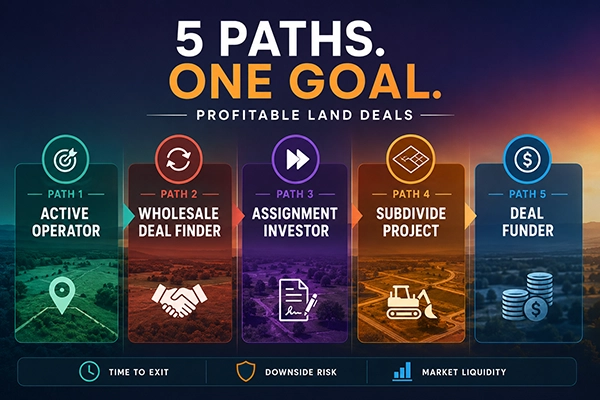
The Common Thread Across All Paths
No matter which path you choose, the fundamentals don’t change.
Land flipping works because land is often mispriced and misunderstood.
But the mechanics only work if your decisions are grounded in reality.
You need to think about:
Time to exit
Downside risk
Liquidity in the market
And whether the deal makes sense today-not under perfect conditions
If a deal only works if everything goes right, it’s not a good deal.
That applies whether you’re flipping one property or funding ten.
Conclusion: Clarity Before Action
Most people don’t fail in land flipping because it’s complicated.
They fail because they start without clarity.
They don’t choose a path.
They don’t match it to their time or capital.
And they don’t stay consistent long enough to see results.
If you want to make money in this business without experience, don’t start with tactics.
Start with a decision.
Choose the path that fits your reality.
Then commit to it long enough to let the process work.
This isn’t about doing everything.
It’s about doing the right thing - consistently.
The last thing I want is for you to build a side business that steals 20 hours a week from your family, keeps you locked away in a home office after a full day of work, or forces you to dip into savings that should be providing security and peace of mind. Land investing should improve your life—not create more stress, tension, or sacrifice than it's worth.
Be thoughtful and deliberate when choosing your path. Pick a strategy that aligns with your goals, your resources, and your family's priorities.
The question isn't which path can make you the most money. The question is which path gives you the best chance of building the life you want while you're building the business.
Land Flipping FAQs
Do I need experience to start flipping land?
No. Most people start with zero experience. What matters more than experience is choosing the right path for your time and capital, then staying consistent long enough to let the process work.
Which land flipping path makes the most money?
It depends on your situation. Operators who build full acquisition systems can hit six figures annually. Deal funders and project players can make more per deal with less volume. The best path is the one that fits your real life not the one that sounds most impressive.
How much capital do I need to get started?
It depends on the path. Assignment investing requires very little capital since you're not closing on properties. Active flipping and subdivide projects require more. Low capital pushes you toward active roles and assignments. More capital opens up larger deals and funding opportunities.
Can I flip land part time?
Yes and it's actually how most people should start. Doing 1 to 3 deals per year on the side is a legitimate path that generates meaningful income without requiring you to quit your job or sacrifice family time.
What is an assignment fee in land investing?
It's the profit you collect when you put a property under contract and sell that contract to another buyer instead of closing on the property yourself. You never own the land you control the deal, pass it off, and get paid the spread.


