

How to Pull a Distressed Vacant Land List for Land Flipping
Most beginners think pulling a distressed land list is the hard part.
It’s not.
The hard part is learning how to think clearly about what you’re actually trying to accomplish before you ever pull a single record. A lot of people get excited about software, filters, and automation because it feels productive. But a distressed list by itself means nothing if the market has weak buyer demand, the pricing makes no sense, or the land is difficult to resell.
I’ve seen people pull massive lists, spend thousands on marketing, and still end up with nothing but dead leads because they skipped the part that actually matters: selecting a market where land consistently moves.
That’s why I treat list building as a filtering process, not a magic button. The goal is not to generate the biggest list possible. The goal is to identify landowners who are statistically more likely to value speed, simplicity, or certainty over squeezing every last dollar out of a property while staying inside markets where you can realistically exit deals.
Once you understand that, PropertyRadar becomes a very powerful tool instead of just another piece of software people play with but never monetize.
Step 1: Select Your Market
In the top-left search field inside PropertyRadar, type the City, County, or ZIP code you want to target.
For this example:
Type: Pinal County, AZ
Select the county from the dropdown menu once it appears
You can add multiple counties or ZIP codes later, but I strongly recommend starting with one market while building your criteria.
One mistake I see repeatedly is beginners chasing random counties simply because the land looks cheap. Cheap land without buyer demand becomes dead inventory very quickly.
I care far more about liquidity than low price.
Before I market anywhere, I want evidence that land is actually selling there consistently.
Step 2: Filter for Vacant Land
From the left-hand Add Criteria menu:
Click Property
Click Property Type
Check the box for Land
Click the green Update Criteria button
This removes houses and other property types from your results.
Sounds simple, but this matters more than people think. You want a clean dataset focused specifically on vacant land owners. The more noise you remove upfront, the easier your underwriting becomes later.
Step 3: Add Distress Filters
From the Add Criteria menu:
Click Other Distress
Click In Distress
Click Select All
Click the green Update Criteria button
This applies distress indicators to the list and helps surface owners who may be more motivated to sell.
Motivation matters because land flipping is not about convincing people to sell property they love. It’s usually about solving a problem for someone who no longer wants the property, no longer uses it, inherited it, lives out of state, or simply wants simplicity and certainty more than maximum price.
That’s an important distinction.
Step 4: Set Lot Size Parameters
From the Add Criteria menu:
Click Property
Click Lot Acres
Input your minimum and maximum acreage
Example:
Minimum: 0.5 acres
Maximum: 165 acres
Click the green Update Criteria button
Adjust this based on the type of land you want to target.
I generally like narrowing acreage because different acreage ranges behave like completely different asset classes. A half-acre infill lot and a 150-acre rural recreational property attract very different buyers and require very different exit strategies.
Step 5: Set Property Value Range
From the Add Criteria menu:
Click Value, Equity & Tax
Click Estimated Value
Input your minimum and maximum estimated value
Example:
Minimum: $40,000
Maximum: $400,000
Click the green Update Criteria button
This helps eliminate properties that are either too cheap or outside your target acquisition range.
Personally, I prefer operating above the ultra-cheap “red ocean” land space where everyone is fighting over tiny deals. The problem with very cheap land is that it often comes with weak demand, difficult usability, poor access, or extremely slow resale velocity.
I would rather own fewer higher-quality deals in stronger markets than accumulate dozens of cheap properties that sit forever.
Velocity matters.
Step 6: Layer Additional Motivation Filters (Optional)
At this point you already have a strong core filter set, but you can increase your odds of finding motivated sellers by layering in additional filters such as:
Absentee owners
Length of ownership
Free and clear ownership
Tax delinquency
Out-of-state owners
These are probability filters, not guarantees.
A lot of beginners treat these filters like magic bullets. They’re not. They simply improve the odds that an owner may be disengaged from the property or more open to a conversation.
The real edge still comes from consistent marketing and follow-up.
Step 7: Create Your List
Once your criteria are finalized:
Click the green Make List button in the top-right corner
Name your list
Uncheck the two optional boxes
Click the green Apply or Make List button
You will then be redirected to your Lists page.
Keep your naming conventions simple and organized. Once you start running multiple campaigns across multiple counties, bad organization creates operational problems fast.
Step 8: Export Your List
On your Lists page:
Locate the list you just created
Click the Connect icon on the list card
Select Export File from the submenu
At this point, your data is ready to move into your CRM, texting platform, direct mail system, or whatever marketing channel you prefer using.
Step 9: Create a Custom Field Set
Before exporting:
Click Create New Field Set
Choose the columns you want included in your export
I highly recommend creating a reusable field set.
Example naming convention:
Default - Land
This saves a massive amount of time long term and keeps your data consistent across campaigns.
Consistency is underrated in this business. The people who build repeatable systems usually outperform the people constantly reinventing their workflow every month.
Step 10: Export the File
After selecting your field set:
Click the green Continue button
Export the file
Your distressed vacant land list is now ready to:
Upload into Lead Boss CRM
Import into another CRM
Send direct mail
Start texting or cold calling
Launch whatever marketing campaign you prefer
The important thing is that you now have a targeted list of vacant landowners with distress indicators already layered into the data.
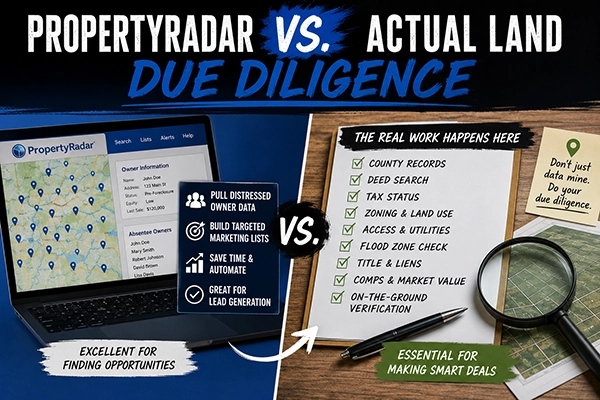
PropertyRadar vs. Actual Land Due Diligence
One important thing to understand is that although PropertyRadar is an excellent tool for pulling distressed owner data and building targeted marketing lists, it is not the tool I personally rely on for actual land due diligence.
Those are two completely different jobs.
PropertyRadar is great for finding potential sellers.
But once I’m evaluating a specific property, I want much deeper visibility into the land itself.
That’s where I prefer using Land Portal.
Land Portal is built specifically for land investors, and it allows you to analyze property characteristics visually using interactive mapping layers like:
Flood zones
Wetlands
Terrain and slope
3D topography views
Access and surrounding development
It also provides AI-powered land comp reports and estimated land values, which helps create a much more realistic understanding of what a property is actually worth in the current market.
That distinction matters because pulling a distressed list is only step one.
The real money is made during the underwriting process — understanding what you’re buying, what the downside risk looks like, and whether there is actual buyer demand for that parcel once you own it.
A cheap property with major usability issues is not automatically a good deal.
And that’s exactly why I separate list building from due diligence.
Final Thoughts
A distressed vacant land list is not a business by itself.
It’s just a starting point.
The real advantage comes from consistently building targeted lists, marketing to owners over and over again, learning how to evaluate deals correctly, and staying active long enough to compound experience.
Most people quit too early because they expect immediate results from a single campaign. That’s not how this business works in the real world.
Some of the best deals come from follow-up months later after everyone else stopped calling.
And one thing I’ve learned over the years is that motivated sellers rarely announce themselves upfront. Motivation usually reveals itself through conversation, timing, consistency, and being the person who actually follows through professionally.
That’s why I care less about fancy tactics and more about repeatable process.
If you can consistently pull quality lists, market in good areas with real buyer demand, price deals conservatively, and stay disciplined with follow-up, this business becomes a lot more predictable than most people realize.
Not easy.
But predictable.
Land Flipping FAQs
What is a distressed land list?
It's a targeted list of vacant landowners who show indicators of motivation things like tax delinquency, absentee ownership, inherited property, or long-term ownership with no activity. These owners are statistically more likely to consider selling at a discount.
What tool does Travis use to pull distressed land lists?
PropertyRadar allows you to filter specifically for vacant land owners and layer in distress indicators like tax delinquency, absentee ownership, and free-and-clear status to build a highly targeted marketing list.
Is a big list better than a small one?
Not necessarily. A smaller targeted list in an active market will almost always outperform a massive list in an area with weak buyer demand. Quality of market matters more than size of list.
What's the difference between PropertyRadar and Land Portal?
PropertyRadar is for finding motivated sellers and building marketing lists. Land Portal is for evaluating the actual property access, flood zones, terrain, comps, and estimated value. They do two completely different jobs.
How many distressed owners will actually respond?
Very few on the first contact and that's normal. The real deals often come from follow-up months later after everyone else stopped reaching out. Consistency and patience are what separate people who do deals from people who quit too early.


