
Is Land Flipping Legit or a Scam? Here's the Honest Truth
Why Land Flipping Feels Suspicious at First
Where Land Flipping Becomes a Scam
The Honest Version of How It Works
The Biggest Mistake Beginners Make
How to Tell If a Land Flip Is Legit
A legit land flip has a clear seller, clear title path, clear property facts, clear pricing logic, and a clear exit.
Is Land Flipping Legit or a Scam?
Land flipping is legit.
But that does not mean every person teaching it is honest, every deal is clean, or every beginner should rush into it because someone on a podcast boasted about their best deal or posted a screenshot of a big check as a flex in a Facebook group.
That is where people get confused. They hear “land flipping” and picture either easy money or a scam. I rarely meet or hear from people that don’t jump to one extreme or the other. The truth is less dramatic and more useful: land flipping is a real business built around buying land below market value and reselling it to someone who values it more. It works when the numbers, property, seller, buyer, and exit all make sense. It fails when people skip judgment and rely on hype.
Why Land Flipping Feels Suspicious at First
I understand why people question it.
The basic idea sounds too simple: find a piece of vacant land, buy it at a discount, then sell it for more. Compared to houses, land looks almost too plain. No renters. No renovations. No contractors walking off the job.
That simplicity makes people suspicious.
But simple does not mean fake. It just means the value is harder to see if you do not understand the market.
Land is mispriced all the time because owners are often disconnected from it. They may have inherited it. They may live out of state. They may have bought it years ago and forgotten about it. They may be tired of paying taxes on something they never use. One we encounter frequently is the husband dies and the wife was on the deed as a joint tenant, she never cared about it and now has no attachment to it.
These landowners are not being tricked. They may value certainty, speed, and simplicity more than squeezing every possible dollar out of the property.
That is the real business.
A Land Flipper makes money by solving that gap. One person wants out. Another person wants the land. The profit comes from connecting those two realities. Think of it like this: you probably paid full price for that treadmill or Peloton when you were excited about building a home gym. Fast forward a few years, and now it’s collecting dust and acting more like a coat rack than workout equipment. You end up selling it on Craigslist or Facebook Marketplace for a fraction of what you paid. It’s not necessarily that the value dropped that dramatically, it’s that your desire to be rid of it became greater than your desire to maximize the price. A lot of vacant land owners feel the exact same way about their property
Where Land Flipping Becomes a Scam
Land flipping itself is not a scam.
But land flipping can be done in scammy ways.
The first red flag is when someone sells the idea as easy money. This business is simple, but it is far from easy money. You still have to pick the right market, price correctly, review the property, talk to sellers, follow up, manage closings, and find buyers.
The second red flag is buying junk land and pretending it is valuable. Some land is cheap because nobody wants it. No access. Bad terrain. Floodplain. No demand. Weird zoning. Too far from buyers. Cheap land is not automatically a deal.
I have seen people buy parcels because the price felt low, then realize later there was no real exit. That is not investing. That is collecting problems.
The third red flag is selling land to buyers without being clear about what they are buying. A clean land deal should not depend on hiding flaws. If the property has no road access, say that. If utilities are far away, say that. If it is recreational land, do not sell it like a ready-to-build homesite.
A good Land Flipper does not need deception. The deal should stand on its own.
The Honest Version of How It Works
A real land flip starts with the market, not the property.
I want to know whether land is actually selling. Are buyers active? Are similar parcels moving? How long are properties sitting? How many are listed? What are the sold comps telling me?
If land is sitting forever, I do not care how cheap it looks.
Once the market makes sense, the property has to pass basic reality checks. Does it have access? Is it usable? Is it in a floodplain? Is the slope reasonable? Are there nearby comps? Can I explain who my buyer will be?
That last question matters more than beginners think.
If I cannot clearly describe the end buyer, I probably do not understand the deal yet.
The offer should be conservative enough that the deal works the day I buy it. I am not buying and hoping appreciation saves me. Hope is not a strategy. If the deal only works under perfect assumptions, I pass.
Then comes the exit. Some properties make sense as cash flips. Some make sense on seller financing. Some might work as an option or double close. Some have value-add potential, like subdividing.
The structure depends on the deal. Not the other way around.
The Biggest Mistake Beginners Make
The biggest beginner mistake is thinking cheap equals safe.
Land feels inexpensive compared to houses, so people overbuy. They pick up five or ten cheap parcels and think they are diversified.
They are not diversified. They are distracted.
Ten slow properties are ten separate problems. Ten tax bills. Ten listings. Ten buyer conversations. Ten chances to realize the market was weaker than expected.
A smaller number of better deals is almost always cleaner than a pile of cheap inventory.
Another common mistake is trusting data without judgment. Data matters. I use it constantly. But land is local. A spreadsheet might tell you the average price per acre. It will not always tell you that buyers hate that side of the county, that the road washes out, or that the parcel shape makes it awkward to use.
Data narrows the range. Judgment sets the price.
That is where experience shows up.
How to Tell If a Land Flip Is Legit
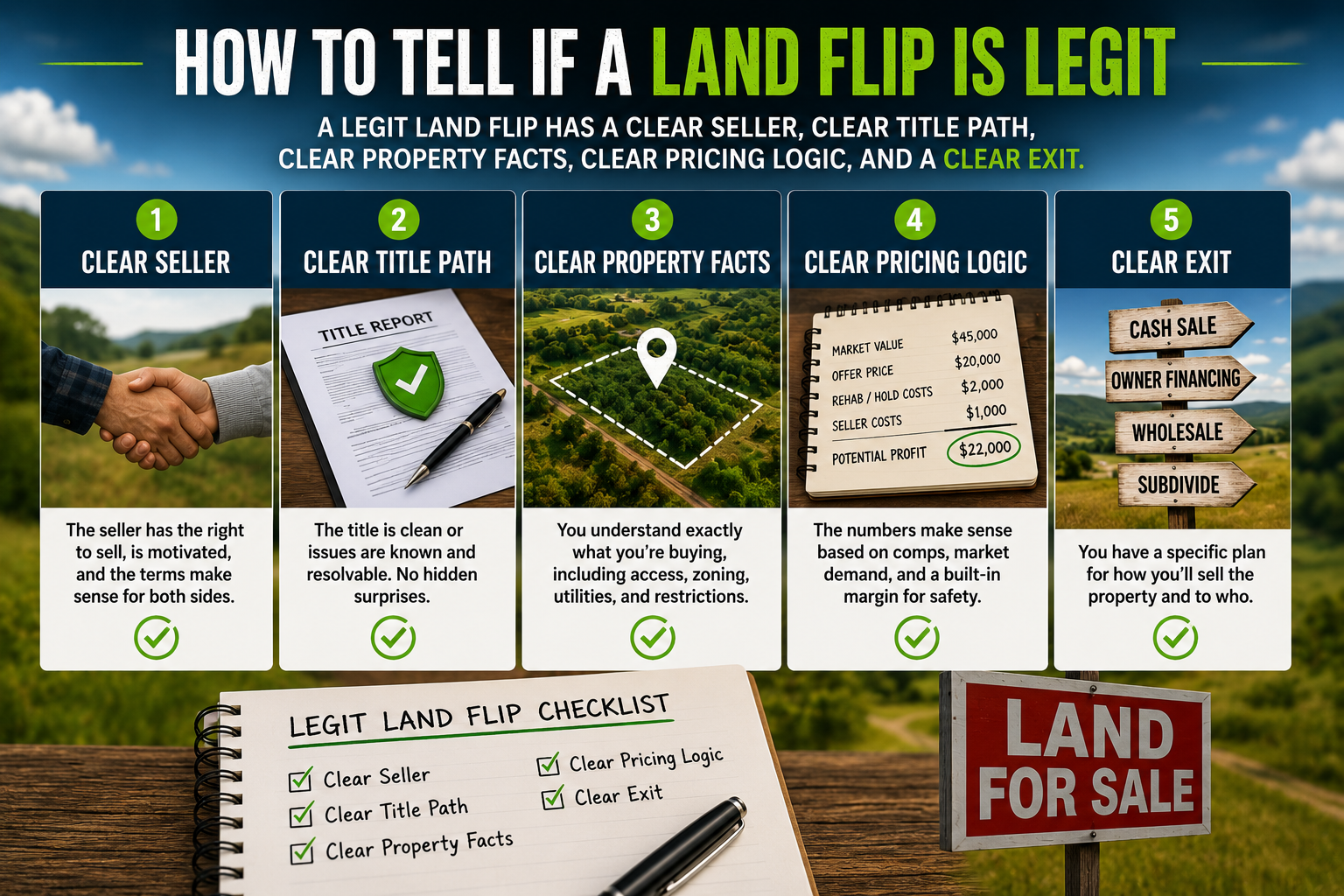
A legit land flip has a clear seller, clear title path, clear property facts, clear pricing logic, and a clear exit.
You should be able to explain the deal in plain language.
“I can buy this for $20,000 because similar usable parcels are selling around $45,000 to $55,000. It has legal access, reasonable terrain, no major floodplain issue, and there are active buyers in this area. I can list it below its full market value and still make a profit.”
That is clear.
Compare that to: “It is cheap, and land always goes up.”
That is not clear. That is guessing.
A legit deal does not require you to ignore problems. It prices around them. If access is weak, the price needs to reflect that. If demand is slow, the price needs to reflect that. If the exit may take longer, the return needs to justify the capital being tied up.
Good land flipping is not about being clever. It is about being disciplined.
So, Is Land Flipping Worth It?
Yes, land flipping can be worth it.
But only for people willing to go into it with their eyes wide open and treat it like a real business, not be lazy with their underwriting or too optimistic about their exit strategy. The exception being if you just want to jump in, do a couple deals and walk away with some profits.
It is not passive in the beginning. It is not push-button income. It is not just mailing offers and waiting for checks. You have to learn markets, make offers, follow up, underwrite deals, avoid bad parcels, and stay consistent when sellers do not respond.
Most of the money is made before you buy.
That is the part people miss.
The profit is not created when you list the land. It is created when you choose the right market, make the right offer, structure the deal correctly, and protect your downside.
Land flipping is legit when it is built on clear thinking and honest execution.
It becomes dangerous when people chase shortcuts, buy land without demand, or confuse cheap prices with good deals.
What I’ve found is that most people getting into land flipping today already know someone doing it or can find a mentor fairly quickly. It’s similar to hiring a contractor for a house remodel you’d probably feel a lot more comfortable hiring someone recommended by a friend, neighbor, or family member than taking a gamble on a stranger. Land flipping works the same way. Get involved in communities, make connections, ask around about whose course or training people actually found valuable, and see if you can identify a mentor with real experience and real results.

I’ve built my reputation helping people one-on-one, one deal at a time. After completing more than 2,500 Zoom coaching calls and seeing hundreds of client testimonials and success stories, I can confidently tell you that land flipping is a very real opportunity. You don’t need to be some investing ninja or unicorn to succeed you simply need to learn from the mistakes of others, shorten the learning curve, and avoid trying to figure everything out alone.
If you’d like me to mentor you on your land flipping journey, I’d be honored if you took a few minutes to learn more about my Land Flipping Mastery course and my Land Boss Group Coaching program.
The clean way to look at it is this: land flipping is not a scam, but it will expose sloppy thinking fast. If you price conservatively, verify the property, understand the buyer, and avoid fragile deals, it can be one of the simplest real estate businesses to understand.
Not easy.
Simple.
Land Flipping FAQs
Is land flipping legal?
Yes. Buying land below market value and reselling it for a profit is completely legal. It only becomes a problem when someone misrepresents a property or hides defects from buyers.
How much money do I need to start?
Less than most people think. Some investors start with a few thousand dollars on smaller rural parcels.
How do I know if a land deal is good?
You should be able to explain it in plain language what you're buying it for, what similar properties have sold for, who your end buyer is, and why. If you can't answer those clearly, the deal isn't ready.
Why is some land cheap without being a good deal?
Because cheap usually means no road access, floodplain issues, bad terrain, or low demand. Always ask why the price is low before deciding whether it's low enough.
Do I need a real estate license to flip land?
Generally no. Investors buying and selling their own properties typically don't need one. Rules vary by state, so if you plan to operate at high volume it's worth a quick conversation with a real estate attorney.


