
Is Land Flipping Risky? The Truth About Risk vs. Uncertainty
Land flipping gets labeled “risky” by people who usually haven’t done it or who did it badly once and blamed the business instead of the decision.
That word, risky, gets thrown around loosely. It hides what’s really going on.
Land flipping isn’t especially risky.
But it is full of uncertainty.
Those two things are not the same, and confusing them is one of the main reasons beginners either freeze or make dumb decisions.
If you understand the difference between risk and uncertainty and learn how experienced operators deal with each land flipping becomes far more predictable than most people expect.
Let’s break this down cleanly.
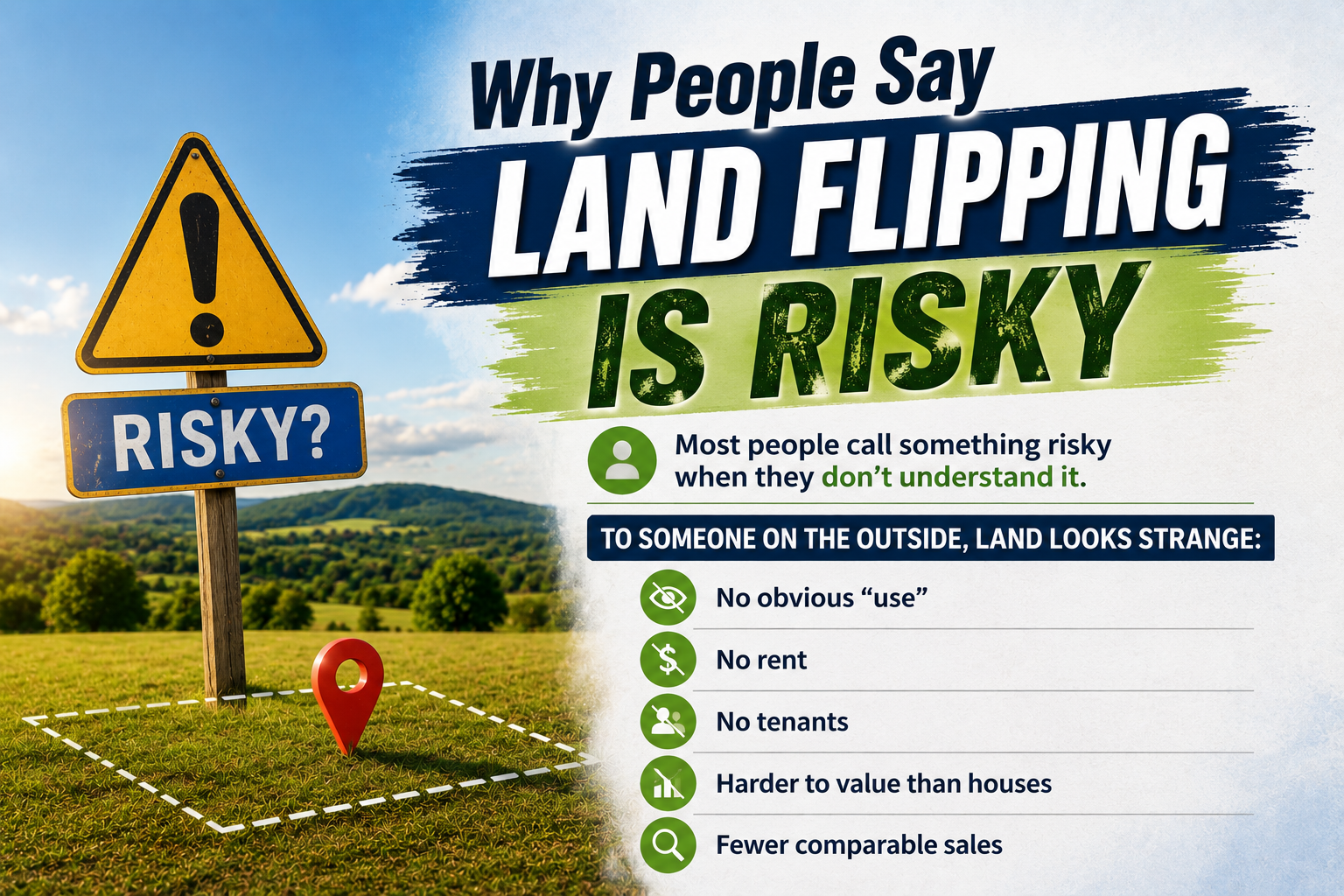
Why People Say Land Flipping Is Risky
Most people call something risky when they don’t understand it.
To someone on the outside, land looks strange:
No obvious “use”
No rent
No tenants
Harder to value than houses
Fewer comparable sales
That unfamiliarity gets translated into fear.
Add a few horror stories someone bought land they couldn’t sell, forgot about back taxes, or discovered access issues after closing and suddenly the whole business gets stamped as dangerous.
But when you look closer, those failures almost always come from bad decisions, not unavoidable risk.
The problem isn’t land.
It’s how people approach it.
Risk vs. Uncertainty (This Matters More Than You Think)
Here’s the distinction most beginners never make.
Risk is when probabilities are known.
Uncertainty is when they aren’t.
Rolling dice is risk.
Starting a new business is uncertainty.
Land flipping lives much closer to uncertainty than risk.
You rarely know outcomes with precision:
Exactly how long it will take to sell
Exactly what price the market will accept
Exactly when a seller will say yes
But that doesn’t mean outcomes are random.
Uncertainty can be managed.
Risk can be mispriced.
Most beginners treat uncertainty like risk and then try to eliminate it entirely. That’s impossible. So they stall.
Experienced investors accept uncertainty and focus on controlling downside.
That’s the real game.
Where Risk Actually Comes From in Land Flipping
Land flipping becomes risky when people do one or more of the following:
Overpay
Buy in dead markets
Ignore access or usability
Hold too many parcels in slow areas
Skip real due diligence
Confuse cheap with safe
None of those are market risks.
They’re operator errors.
Land doesn’t surprise you the way tenants do. It doesn’t break. There are no work orders or tickets from property management. It doesn’t stop paying rent because there is no rent.
Most “risk” in land is front-loaded at acquisition. If you buy wrong, you feel it. If you buy right and perform proper due diligence, land is boring in a good way, because there are little to no surprises.
The Biggest Difference Between Houses and Land (From a Risk Perspective)
Houses feel safer because they’re familiar.
But familiarity isn’t the same as safety.
Houses carry ongoing operational risk:
Tenants
Maintenance
Repairs
Liability
Vacancy
Evictions
Insurance claims
Land carries pricing and liquidity risk:
Can you sell it?
How fast?
At what price?
Once you understand that tradeoff, land becomes easier to manage, not harder.
I’d rather underwrite liquidity once than manage human behavior every month.
Why Land Feels Riskier Than It Is
Land exposes uncertainty early.
With houses, problems show up slowly:
Deferred maintenance
Bad tenants
Gradual cash flow erosion
With land, mistakes show up fast:
It doesn’t sell
Buyers don’t respond
You misread the market
It’s not buildable
That immediate feedback is uncomfortable for beginners but it’s actually a strength.
You don’t get false confidence from cash flow that hides long-term issues. You find out quickly whether you were right or wrong.
The Real Risk Is Illiquidity
If you want to understand land risk in one word, it’s this:
Illiquidity.
Land that doesn’t sell is risk.
Land that sells slowly ties up capital.
Land with no clear buyer is dead weight.
That’s why market selection matters more than almost anything else.
A mediocre deal in a liquid market is often safer than a great deal in a thin one.
Beginners obsess over discounts. Experienced operators obsess over exits.
5 Ways Experienced Investors Reduce Risk Without Eliminating Uncertainty
They don’t try to be perfect.
They try to be robust.
Here’s what that looks like in practice.
1. They Buy With Margin Built In
The biggest risk reducer is buying well below realistic market value.
Not “best-case” value.
Not “Zillow-high” value.
Realistic, sellable value.
That margin gives you room to be wrong:
On price
On timing
On demand
If you need perfect execution for a deal to work, it’s fragile.
2. They Choose Markets Where Land Actually Moves
Land risk isn’t about price it’s about velocity.
If land sells consistently in a market:
Mistakes are forgivable
Exits exist
Capital turns
If land sits forever:
Every mistake compounds
Capital gets trapped
Stress rises
Liquidity is your insurance policy.
3. They Care More About Downside Than Upside
Beginners ask, “How much can I make?”
Experienced investors ask:
“What happens if I’m wrong?”
“How ugly does this get?”
“Can I exit without damage?”
If the downside is manageable, uncertainty becomes tolerable.
4. They Avoid Binary Bets
Binary bets are deals that only work one way.
For example:
One buyer type
One price point
One exit path
Good land deals often have multiple exits:
Cash sale
Seller financing
Different buyer avatars
Price flexibility
Optionality reduces risk.
5. They Limit Exposure Per Deal
Land feels cheap, which tricks people into overbuying.
Ten slow parcels are not diversification.
They’re ten locked doors.
Experienced investors control:
How much capital is tied up
How long it’s tied up
How many “unknowns” exist at once
They’d rather do fewer, cleaner deals than stack inventory.
Why Beginners Feel More Risk Than Actually Exists
Because they don’t trust their judgment yet.
Early on, everything feels uncertain:
Pricing
Markets
Sellers
Buyers
So they try to compensate with:
More research
More rules
More hesitation
But land investing doesn’t reward hesitation.
It rewards conservative action.
You learn judgment by making offers, not by avoiding them.
The Hidden Risk of “Playing It Safe”
Ironically, the safest-looking behavior often creates the most risk.
Examples:
Waiting for the “perfect” deal
Only buying ultra cheap land in dead markets
Holding inventory too long to squeeze extra profit
Refusing to adjust price or offer terms when the market speaks
Playing it safe by avoiding uncertainty usually just delays feedback and magnifies mistakes.
Land Flipping vs. Other Investment Risks
Compared to many alternatives, land risk is extremely transparent.
There’s no leverage required.
No tenants.
No surprise repairs.
No regulatory rent caps.
No eviction moratoriums.
Your exposure is visible the day you buy.
You know:
Your basis
Your carrying costs
Your exit options
That clarity is rare.
Why Most “Risk Stories” Are Operator Stories
When someone says, “Land flipping burned me,” the follow-up almost always reveals:
They overpaid for the land
They ignored access
They didn’t check slope
They bought where nothing sells
They assumed appreciation
They skipped basic checks
That’s not systemic risk.
That’s a learning curve.
Every business has one.
The Truth Most People Miss
Land flipping isn’t risky in the way people think.
It doesn’t blow up suddenly.
It doesn’t hide damage.
It doesn’t create surprise expenses.
What it does is force you to think clearly.
If you’re sloppy, land exposes it.
If you’re disciplined, land rewards it.
The business doesn’t forgive optimism but it does reward conservatism.
So… Is Land Flipping Risky?
Only if you confuse uncertainty with danger.
Land flipping involves uncertainty:
Timing
Pricing
Human behavior
But uncertainty is manageable.
Risk comes from:
Overconfidence
Poor market selection
Ignoring exits
Treating cheap as safe
When you buy with margin, focus on liquidity, and control downside, land flipping becomes one of the more predictable real estate businesses out there.
Not because it’s easy.
But because the rules are simple and the feedback is honest.
That’s not risk.
That’s clarity.
Land Flipping FAQs
What's the difference between risk and uncertainty in land flipping?
Risk involves known probabilities (like rolling dice), while uncertainty means outcomes aren't precisely predictable. Land flipping involves uncertainty you may not know exactly when a parcel will sell or at what price but that uncertainty can be managed through smart buying and market selection.
What actually makes land flipping go wrong?
Almost always operator error, not the market itself. Overpaying, buying in illiquid markets, skipping due diligence, ignoring access or usability issues, and confusing "cheap" with "safe" are the most common culprits.
How is land flipping different from investing in rental properties?
Rentals carry ongoing operational risks like tenants, maintenance, vacancies, and evictions. Land's main risks are pricing and liquidity can you sell it, how fast, and at what price? Many experienced investors prefer underwriting liquidity once over managing human behavior every month.
What is the single biggest risk in land flipping?
Land that doesn’t sell quickly at a fair price ties up your capital and compounds mistakes. That’s why experienced investors prioritize market selection—a mediocre deal in a liquid market (where properties move fast) is often safer than a great deal in a thin market (where buyers are scarce).
How do experienced land flippers manage uncertainty?
They buy with a significant margin below realistic market value, choose markets where land moves consistently, focus on protecting the downside rather than chasing upside, build in multiple exit options, and limit how much capital is tied up in any single deal.


