
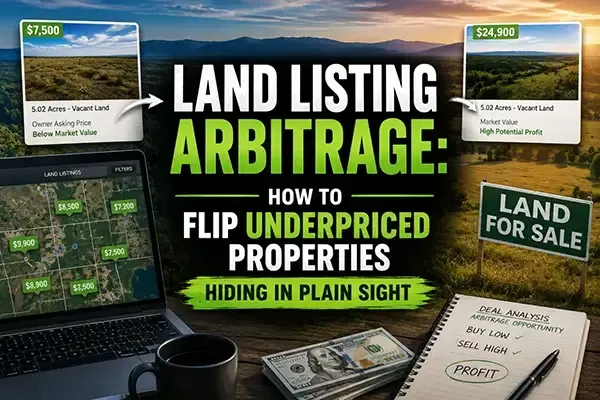
Land Listing Arbitrage: Flip Underpriced Properties
The Land Flipper’s Guide to Listing Arbitrage
Most land flippers think the property itself is the opportunity.
Sometimes it is.
But sometimes the real opportunity is simply better marketing, better positioning, and better exposure.
That distinction matters more than most people realize.
I’ve watched investors spend months chasing difficult off-market deals while completely ignoring publicly listed properties sitting right in front of them with terrible presentation, weak visibility, and poor pricing strategy. Meanwhile, another investor takes the exact same parcel, repositions it properly, puts it in front of a stronger buyer pool, and sells it for dramatically more.
Same land.
Different operator.
That is listing arbitrage.
And once you understand how it works, you stop looking at marketplaces like simple advertising platforms. You start viewing them as separate economic environments with different buyer behavior, different pricing expectations, and different levels of competition.
That shift changes how you evaluate deals entirely.
You stop asking:
“What is this property worth?”
And you start asking:
“Which platform values this property the most?”
That’s a much more sophisticated question.
Because land pricing is not nearly as universal as people think.
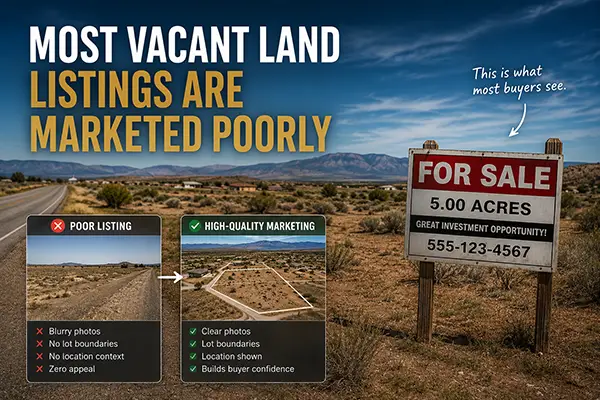
Most Vacant Land Listings Are Marketed Poorly
One of the biggest misconceptions newer land flippers have is assuming listed inventory is already optimized.
It usually isn’t.
A shocking percentage of vacant land listings are terrible.
I’m talking about:
Blurry photos
No maps
No parcel overlays
Weak descriptions
No financing options
No utility information
No GPS coordinates
Incorrect acreage
Poor pricing strategy
Missing access details
Sometimes the seller owns a perfectly solid parcel, but the listing itself kills buyer interest before the buyer even finishes scrolling.
I see this constantly on:
Craigslist
Facebook Marketplace
Smaller land platforms
Weak FSBO listings
Poorly managed MLS listings
Meanwhile, the same property marketed properly on Zillow, Land.com, Redfin, or the MLS can command substantially stronger pricing.
Why?
Because exposure matters.
Presentation matters.
Buyer intent matters.
The buyer casually browsing Facebook Marketplace behaves very differently than the buyer searching Zillow nightly looking for acreage to build on.
Different buyer pools assign different values to the same property.
That creates inefficiencies.
And inefficiencies create opportunity.
A lot of investors miss this because they focus entirely on acquisition.
But land flipping is really a combination of:
Acquisition
Pricing
Positioning
Distribution
Buyer psychology
Distribution is the part most people underestimate.
The marketplace itself has value.
The Same Property Can Sell for Different Prices on Different Platforms
This is the part most beginners struggle to believe until they see it themselves.
They assume market value is fixed.
It isn’t.
Market value is heavily influenced by:
Buyer visibility
Platform exposure
Financing structure
Audience quality
Presentation quality
Buyer intent
I’ve seen properties sit stale on Craigslist for months with no activity and then sell quickly once repositioned onto Zillow with cleaner photos and stronger presentation.
I’ve also seen the reverse.
Sometimes recreational buyers on Land.com will pay dramatically more per acre than buyers on Zillow. Other times Zillow buyers outperform because they are focused on buildable land instead of recreational acreage.
The arbitrage works both ways.
That’s important.
Most people think listing arbitrage only means:
“Find cheap land on Facebook and resell it on Zillow.”
Sometimes that works.
But I’ve also seen:
Cheap Zillow listings outperform on Land.com
Weak MLS listings outperform on LandWatch
Craigslist listings outperform once repositioned to Facebook Marketplace
Land.com inventory outperform after moving onto the MLS
There is no universal rule.
You are not looking for “the best platform.”
You are looking for pricing inefficiencies between buyer pools in a specific market.
That’s the real game.
Why Listing Arbitrage Opportunities Exist
Most inefficient markets exist because people are inconsistent, distracted, lazy, or uninformed.
Land is no different.
A large percentage of sellers:
Don’t understand pricing
Don’t understand marketing
Don’t understand buyer psychology
Don’t understand platform differences
Don’t want to spend time improving listings
Some inherited the property and simply want it gone.
Others listed the parcel once, got little traction, and mentally checked out.
Some copied another listing without understanding why it was priced that way in the first place.
All of this creates weak inventory.
And weak inventory creates opportunity for operators who understand positioning.
Over the years, I’ve realized something important:
A surprising amount of land arbitrage is not actually buying undervalued land.
It’s buying undervalued attention.
That’s a very different lens.
Sometimes the seller’s asking price is already fair.
The problem is nobody sees the listing.
Or the listing fails to communicate value correctly.
That’s where better operators win.
A clean listing with:
Good maps
Better photography
Drone imagery
Financing options
Utility information
Nearby attractions
GPS coordinates
Boundary overlays
Better descriptions
…can dramatically outperform weaker listings in the same market.
Especially in rural land where buyers are making decisions remotely.
The listing itself becomes the buyer experience.
That matters far more than most people realize.
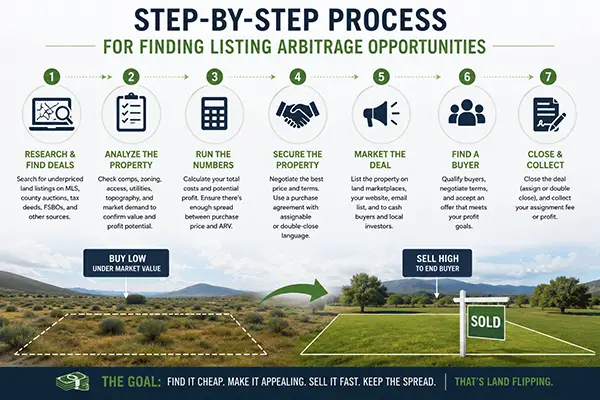
Step-by-Step Process for Finding Listing Arbitrage Opportunities
The actual process is simple.
The challenge is developing the judgment to determine whether the spread is real or misleading.
Most people overcomplicate this. They think there’s some hidden software or secret source of data.
There isn’t.
You are simply comparing marketplaces side-by-side and identifying pricing inconsistencies.
One of the easiest ways to do this is by comparing Zillow and Land.com in the same county using the same acreage ranges.
Step 1: Build the Zillow Search
Start with Zillow.
Search your target county and filter strictly for:
Lots/Land only
Matching acreage ranges
Active inventory only
Then sort the listings from low to high price.
I usually keep Zillow open on one side of the screen and Land.com on the other so I can compare pricing behavior in real time.
At this stage, you are not evaluating deals yet.
You are studying buyer behavior.
That distinction matters.
Step 2: Mirror the Search on Land.com
Now pull the same county on Land.com.
Use:
The exact same acreage range
Undeveloped land only
Active listings only
Price low-to-high sorting
Now compare both platforms side-by-side.
This is where things get interesting.
You’ll start noticing:
Different pricing behavior
Different price-per-acre averages
Different listing quality
Different buyer positioning
Different inventory saturation
Sometimes Zillow inventory is substantially cheaper.
Other times Land.com inventory commands a major premium.
You are looking for evidence that one marketplace consistently supports stronger pricing for similar land.
Step 3: Compare Similar Properties Correctly
Now start comparing:
Similar acreage
Similar terrain
Similar access
Similar utility availability
Similar usability
This is where inexperienced investors get themselves in trouble.
A 40-acre recreational parcel should not be compared to a 40-acre homesite parcel just because the acreage matches.
You are not comping acreage alone.
You are comping utility.
That’s a massive difference.
Step 4: Run Due Diligence and AI Comp Validation
This is the step beginners usually rush through.
A cheaper property is not automatically an arbitrage opportunity.
Sometimes the parcel is cheap because:
Access is terrible
Floodplain issues exist
Terrain is unusable
Utilities are unrealistic
Demand is weak
The parcel shape is awkward
The market is saturated
Before assuming the spread is real, I’ll usually run the property through Land Portal to quickly validate the basics.
This helps me verify things like:
Access
Floodplain exposure
Terrain
Wetlands
Parcel boundaries
Nearby activity
Estimated market value
I’ll also run an AI comp report through Land Portal to get a fast estimated value range before spending deeper underwriting time on the property.
I do not blindly trust automated valuations.
That’s important.
Comp tools are inputs, not final answers.
Land is still highly local, and property-specific realities override spreadsheets constantly. But AI comp reports are extremely useful for narrowing the range quickly and identifying which properties deserve deeper underwriting.
The AI comp report helps establish a starting point.
Judgment confirms whether the pricing actually makes sense in the real market.
Step 5: Reposition the Property on the Stronger Platform
Once you identify a real spread, the next step is improving the positioning.
This is where operators create value.
Usually that means:
Better photos
Drone imagery
Cleaner maps
Boundary overlays
Better descriptions
GPS coordinates
Financing options
Utility explanations
Better platform exposure
Sometimes this alone creates a massive pricing improvement.
No rezoning.
No development.
No subdividing.
Just better positioning.
That’s the part most people underestimate.

Better Marketing Alone Can Create Massive Value
A lot of newer investors assume value creation always means:
Entitlements
Improvements
Development
Rezoning
Infrastructure
Sometimes it does.
But sometimes the value creation is simply operational competence.
I’ve watched investors create huge spreads simply by:
Repricing correctly
Improving photos
Adding seller financing
Using drone imagery
Improving descriptions
Expanding exposure
Moving inventory onto stronger platforms
That’s it.
Same parcel.
Different presentation.
Different buyer response.
Seller financing especially changes buyer psychology dramatically in land.
Many land buyers care more about monthly affordability than total purchase price.
A property listed at:
$49,000 cash
…may suddenly outperform at:
$69,000 with financing
Same property.
Different structure.
Different buyer pool.
This is why flexibility matters so much in land investing.
Experienced operators do not think in single exits.
They think in optionality.
That optionality creates opportunity.
The Real Edge Is Thinking Like an Operator
Most beginners browse listings like consumers.
Experienced land flippers analyze listings like operators.
That difference matters.
Consumers ask:
“Would I buy this?”
Operators ask:
“Why hasn’t this sold?”
That one question changes everything.
You start noticing:
Weak presentation
Incorrect pricing
Poor visibility
Weak descriptions
Bad photos
Wrong platform selection
Missing financing
Market mismatch
You stop emotionally reacting to properties and start evaluating systems.
That’s the real skill.
Some of the best opportunities I’ve ever seen were not hidden off-market deals.
They were publicly visible listings everyone else ignored because the marketing was weak.
That’s why I always tell newer investors not to become obsessed with “secret deals.”
Sometimes the edge is simply being more competent than the seller.
That sounds overly simple, but I’ve seen it repeatedly.
One seller uploads three blurry photos to Craigslist and gets no traction.
Another investor creates:
Drone imagery
Boundary overlays
Seller financing
Utility maps
Better descriptions
MLS exposure
…and suddenly the property sells quickly at a dramatically stronger price.
Same land.
Different operator.
That is listing arbitrage.
Final Thoughts
Listing arbitrage works because land markets are inefficient.
Different platforms attract different buyers.
Different buyers assign different values.
Different sellers market property differently.
That creates pricing gaps.
And pricing gaps create opportunity.
The key is understanding that you are not just buying land.
You are buying positioning opportunities.
Sometimes the best deal is not the cheapest property.
Sometimes it is the poorly marketed property with enough room for:
Better exposure
Better presentation
Better financing
Better positioning
Better buyer targeting
Once you start viewing Zillow, Land.com, Facebook Marketplace, Craigslist, and the MLS as separate economic environments instead of simple advertising platforms, you start seeing opportunities most people completely miss.
That’s where the edge starts.
And in many cases, the investor who wins is not the one who found the best property.
It’s the one who understood the marketplace better.
Land Flipping FAQs
What is listing arbitrage in land flipping?
It's finding properties that are underpriced or poorly marketed on one platform and reselling them at a higher price on a platform with stronger buyer demand same land, better positioning, bigger profit.
Do I need to buy the property to do listing arbitrage?
Yes. You're purchasing the property, improving the presentation and platform exposure, then reselling it at a higher price. The value you create comes from better marketing and stronger buyer targeting, not physical improvements to the land.
Why does the same property sell for different prices on different platforms?
Because each platform attracts a different type of buyer with different pricing expectations. A recreational land buyer on Land.com may pay significantly more per acre than a buyer casually browsing Zillow and vice versa depending on the market.
Does better marketing really make that big of a difference?
Yes. Drone photos, boundary overlays, GPS coordinates, seller financing, and stronger descriptions can dramatically change buyer response on the exact same parcel. Most vacant land listings are shockingly weak, which creates real opportunity for investors who know how to present property correctly.
How do I find listing arbitrage opportunities?
Pull up Zillow and Land.com side by side in the same county with matching acreage filters and compare pricing behavior. When you consistently see one platform commanding higher prices for similar properties, that gap is where the opportunity lives.


