

The Land Flipping Lie Nobody Talks About
Why “I Need More Training First” Is the Most Expensive Lie
“I just need a little more training first.”
It sounds responsible. Thoughtful. Mature.
It’s also the most expensive lie people tell themselves when trying to get into land investing or any execution-based business. I can say that with certainty because I was guilty of it myself when I was getting started… or more accurately, when I was stuck in learning mode.
I’ve heard this sentence from smart people with good intentions for years. They don’t say it because they’re lazy. They say it because they want to do things right. They want to avoid mistakes. They want confidence before committing.
The problem is that this belief quietly inverts how progress actually works.
In land investing, more training rarely creates clarity. Action does. And the longer someone delays action in the name of preparation, the more money, time, and momentum they burn without realizing it.
Let’s talk about why this lie feels so reasonable, why it’s so costly, and what actually moves people forward instead.
Why This Lie Feels Responsible
“I need more training first” feels like the adult answer.
It sounds disciplined. It signals caution. It protects ego. It gives you a reason to stay still without admitting fear.
And socially, it’s rewarded. No one criticizes someone for “learning more.” No one calls it procrastination. In fact, it often gets encouragement.
The issue is that land investing is not a knowledge problem after a very basic threshold. It’s a judgment problem. And judgment does not come from consuming information.
It comes from making decisions with incomplete information and seeing what happens.
That’s the part training cannot replace.
The Hidden Assumption Behind “More Training”
When someone says they need more training, they’re usually assuming one of three things:
At some point, I’ll feel ready
There is a correct way to do this that I haven’t learned yet
If I train enough, I can avoid mistakes
All three assumptions are false.
Readiness does not arrive before action. It arrives after repetition.
There is no single correct way to do land deals only ranges that work and ranges that don’t.
And mistakes are not something training eliminates. They’re something experience makes smaller and cheaper.
Training doesn’t prevent errors. It just delays them.

Why Training Feels Like Progress (But Isn’t)
Training creates the feeling of progress without the risk of exposure.
You can:
Watch videos
Read books
Take notes
Build spreadsheets
Organize folders
Compare strategies
And none of it requires you to be wrong publicly or privately.
No seller can reject you.
No buyer can ignore you.
No deal can fall apart.
So your brain stays comfortable while telling itself it’s being productive.
But comfort is not neutral here. Comfort is costly.
Because while you’re training:
Markets are giving signals you’re not seeing
Sellers are making decisions without you
Your judgment isn’t being exercised
Your confidence isn’t being earned
You’re not standing still. You’re falling behind reality.
The Cost of Waiting Is Invisible At First
The most dangerous cost of “more training” is that it doesn’t feel like a cost.
There’s no invoice.
No red number in a bank account.
No obvious failure.
Instead, the cost shows up quietly as:
Missed deals
Delayed feedback
False certainty
Growing fear of starting
Six months of extra training rarely makes someone better at land investing. But it almost always makes starting feel heavier.
The longer someone waits, the more pressure they put on their first move. It has to be right. It has to work. It has to justify all the time spent preparing.
That pressure is not a recipe for good decisions.
Why More Training Can Actually Make You Worse
This part surprises people.
More training can actually reduce performance early on.
Why?
Because it floods beginners with edge cases before they understand the core. They start worrying about:
Rare legal scenarios
Complex deal structures
Extreme risks
Sophisticated optimizations
Before they’ve ever priced a basic parcel or sent a simple offer.
Their mental stack gets overloaded. They hesitate. They second-guess. They freeze.
They know too much about what could go wrong and not enough about how things usually go right.
This is how people end up “educated” but inactive.

What Actually Changes After the First Real Action
Everything changes the moment someone does one real thing:
Sends their first offers
Talks to a real seller
Gets a counteroffer
Lists a property
Has a buyer ask a question they didn’t anticipate
Suddenly, the business stops being theoretical.
The noise drops.
The fear becomes specific.
The questions get sharper.
The learning accelerates.
One big campaign teaches more than three courses—because it’s grounded in reality.
Until then, everything is imaginary.
The Myth of the Perfect First Deal
Another reason people hide behind training is the belief that the first deal matters too much.
They want it to:
Be profitable
Be clean
Be impressive
Prove they’re competent
So they wait until they feel capable of pulling that off.
That’s backwards.
The first deal’s real job is not to make money. It’s to collapse uncertainty.
It’s supposed to be imperfect.
It’s supposed to teach.
It’s supposed to feel awkward.
The people who make this business work long-term are the ones who let the early reps be messy and small.
Perfection is not the entry fee. Action is.
The Real Learning Curve in Land Investing
Here’s the part training can’t shortcut.
Land investing is about:
Pricing under uncertainty
Reading market response
Understanding seller motivation
Managing downside
Choosing when not to do a deal
Those are judgment skills.
You can’t download judgment.
You can’t watch someone else do it and absorb it.
You can’t simulate it safely.
Judgment only forms when your decisions have consequences even small ones.
That’s why two people can take the same training and have wildly different results. One acts. One doesn’t. Only one develops judgment.
“But I Don’t Want to Make a Costly Mistake”
This is the most honest version of the lie.
And it’s understandable.
But here’s the uncomfortable truth: avoiding all mistakes guarantees a much bigger one later.
When people delay action too long:
They overthink their first deals
They deploy too much capital at once
They take bigger risks to “make it worth it”
They have no muscle memory to rely on
Small, early mistakes are cheap. Large, delayed mistakes are expensive.
The safest path is not avoiding errors it’s making controlled, reversible ones early.
Why Experienced Investors Don’t Think This Way
You rarely hear experienced operators say, “I need more training first.”
Not because they know everything but because they know how learning actually happens.
They learn by:
Testing ideas in the market
Watching response
Adjusting
Repeating
Training becomes a supplement, not a substitute.
They might learn something new and apply it immediately. Or they might ignore it and table it for later because it doesn’t fit their current reality.
Experience filters information. Beginners don’t have that filter yet so they drown in it.
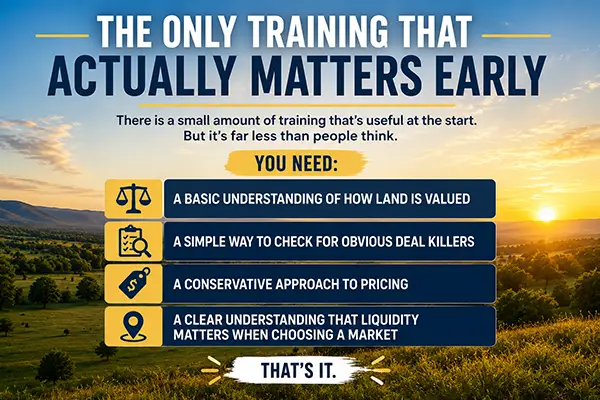
The Only Training That Actually Matters Early
There is a small amount of training that’s useful at the start. But it’s far less than people think.
You need:
A basic understanding of how land is valued
A simple way to check for obvious deal killers
A conservative approach to pricing
A clear understanding that liquidity matters when choosing a market
That’s it.
Everything else can and should be learned after you’ve engaged the market.
If your next step doesn’t involve contacting real sellers or buyers, you’re probably stalling.
The Opportunity Cost No One Talks About
While someone is “getting ready,” someone else with less knowledge but more action is building momentum.
They’re:
Learning faster
Building confidence
Developing intuition
Creating deal flow
This isn’t a moral judgment. It’s just how execution-based businesses work.
The market doesn’t reward preparation. It rewards participation.
What People Mean When They Say “I Need More Training”
Let’s be blunt.
Most of the time, it translates to:
“I don’t trust my judgment yet.”
“I’m afraid of being wrong.”
“I don’t want to feel stupid.”
“I don’t want to lose money.”
Those are human fears. Not technical gaps.
And no amount of training eliminates them.
Only action does.
A Better Question to Ask Instead
Replace this question:
“Do I need more training?”
With this one:
“What is the smallest real action I can take that gives me feedback?”
That might be:
Sending one small batch of offers
Calling one seller back
Comping out one property
Calling one agent
You don’t need courage for a giant leap. You need honesty for a small step.
The Compounding Effect of Early Action
The people who win in land investing don’t start smarter. They start sooner.
Early action compounds:
Confidence
Skill
Pattern recognition
Speed of decision-making
Waiting compounds doubt.
And the longer someone waits, the harder it feels to start because now there’s identity wrapped up in “being prepared.”
The Truth, Stated Clearly
“I need more training first” is not a strategy. It’s a delay mechanism.
Training has diminishing returns very quickly in land investing. Action does not.
The goal is not to feel ready.
The goal is to start small enough that readiness doesn’t matter.
Send offers.
Get feedback.
Adjust.
Repeat.
That’s how clarity is earned.
Not in another podcast.
Not in another Youtube video.
Not in another podcast episode.
In the market.
That’s where the real training is.
Land Flipping FAQs
How much training do I actually need before starting land flipping?
Very little. You need a basic way to value land, a simple checklist for obvious deal killers, and a conservative pricing approach. That's it. Everything else is learned faster by making real offers than by taking another course.
What if I make a costly mistake because I started too soon?
Small early mistakes are the cheapest ones you'll ever make. Waiting too long is actually riskier — you'll eventually start with more capital, more pressure, and zero experience. The goal isn't to avoid mistakes. It's to make small, reversible ones while the stakes are still low.
How do I know if I'm genuinely not ready or just stalling? Ask yourself one question: does my next step involve contacting a real seller or buyer? If not, you're stalling. Discomfort before action is normal — experienced investors feel it too. They just don't confuse it with a reason to keep preparing.


