

What Your First Year Land Flipping Actually Looks Like
What a Realistic First Year as a Land Flipper Looks Like
Most people picture their first year in land flipping going one of two ways.
Either they imagine fast wins, big spreads, and smooth momentum from the first few months…
or they quietly fear months of confusion, wasted money, and no deals at all.
Both expectations are wrong.
Before we go any further, it’s important to be clear about who this article is for.
If your goal is to get in, do one or two quick flips, make a chunk of cash, and get back out — this article isn’t really aimed at that path.
There’s nothing wrong with that approach. But that’s a transaction goal, not a business goal.
This article is written for people who want to build a real side business, not a short-term side hustle — something that can reliably produce a six-figure second income over time, not just generate a six-figure year once.
If that’s the lane you’re in, then having realistic expectations for year one matters a lot.
A realistic first year in land flipping is not glamorous. It’s not linear. And it’s not evenly profitable across all twelve months. But it is predictable if you understand what you’re actually building during that year.
The Real Goal of Year One (That Almost No One Talks About)
The biggest mistake beginners make is thinking the first year is about income.
It’s not.
The real goal of your first year is building the foundation and getting through the learning curve without tapping out and giving up.
You’re learning how to:
Price land without perfect information
Pick markets that actually move
Talk to sellers without forcing deals
Walk away from bad properties before they cost you
If your only objective is to do a couple of deals and move on, you can shortcut some of this.
If your objective is to build a repeatable income stream, you can’t.
People who chase income too early tend to:
Overpay to force deals
Buy in thin or unstable markets
Hold inventory too long
Take unnecessary risks just to justify the effort
People who focus on building the foundation end year one calmer, clearer, and far better positioned to stack consistent deals in year two and beyond.

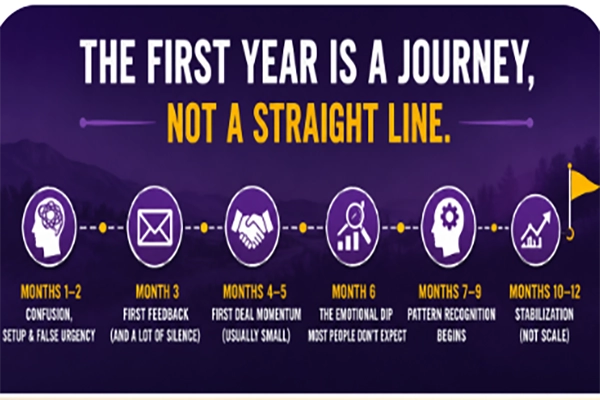
Months 1–2: Confusion, Setup, and False Urgency
The first 30–60 days feel heavier than they need to.
This is when most beginners:
Consume too much content
Overthink market selection
Obsess over tools and tactics
Feel pressure to “get it right”
Nothing is broken here. This is normal.
You’re seeing the full surface area of the business for the first time, and your brain is trying to solve everything at once. That’s where overwhelm comes from.
A realistic first two months include:
Narrowing to one market (not five)
Sending your first real offers — usually later than you think you should
Learning how to pull comps imperfectly
Building a simple, conservative offer approach
If you’re trying to build a business, this phase is unavoidable. You’re setting the base layer everything else will sit on.
This phase ends the moment offers go out.
Month 3: First Feedback (And a Lot of Silence)
Month three is where reality shows up.
This is when beginners usually say, “Nothing is happening.” This is specifically referring to your first direct mail campaign
Here’s what’s actually happening:
Sellers are receiving your offers
Some are considering them quietly
Some are setting them aside
Some are waiting until their situation changes
Low response rates are normal. Silence is normal. No immediate deals is normal.
This is where people with a “quick win” mindset often bail.
People trying to build a side business stay put and adjust.
A realistic month three looks like:
A few seller calls or emails
Frustration around pricing
Realizing your offers may be too low — or occasionally too high
Adjusting assumptions
This is feedback, even if no deal closes yet. If you chose to do a texting or cold calling campaign as your first campaign it would be more likely that you are experiencing an overwhelm of leads and struggling to keep head above water qualifying properties and getting back to sellers. That’s the difference between direct mail and other marketing channels. Direct mail will bring far fewer leads at a much greater cost per lead, but they are generally more motivated leads. Cold calling and texting will bring a high volume of total response but many more leads to a deal.

Months 4–5: First Deal Momentum (Usually Small)
Most first deals don’t come quickly — and they’re rarely impressive.
That’s a good thing.
A realistic first deal is:
Smaller than you hoped
Slower than you expected
Messier than the podcasts you heard
But it changes everything.
Once a deal gets under contract, the business stops feeling theoretical. Suddenly:
Due diligence matters
Exit planning becomes real
Pricing feels less abstract
If your goal is a one-off score, this deal might feel underwhelming.
If your goal is a long-term second income, it’s a milestone.
For many people, the first deal happens somewhere in months four or five. Some sooner, some later but this is the most common range for those who stay consistent.
Month 6: The Emotional Dip Most People Don’t Expect
Month six is dangerous not because nothing is happening, but because something has happened and expectations reset.
This is when people start thinking:
“I should be further along by now.”
“Why isn’t this scaling faster?”
“Other people seem to be doing better.”
“The expenses are starting to stack up.”
The novelty has worn off, but mastery hasn’t arrived yet.
You now know enough to see your own mistakes, but not enough to avoid them consistently. That gap creates frustration.
A realistic month six includes:
One or two completed acquisitions but none have resold yet
Inconsistent deal flow
Second-guessing your market
Questioning whether the effort matches the return
This phase filters out hobbyists from builders.
Months 7–9: Pattern Recognition Begins
This is the quiet turning point.
Somewhere between months seven and nine:
You comp and value properties faster
You recognize bad deals sooner
Seller conversations feel more natural
Silence or unmotivated sellers stops feeling personal
This isn’t confidence. It’s familiarity.
You’re no longer trying to “figure out land investing.” You’re running a process and watching outcomes.
For someone building a side business, this is where the work starts to feel lighter not because it’s easy, but because it’s no longer mentally exhausting.
Months 10–12: Stabilization (Not Scale)
Most first years do not end with scale.
They end with stability.
That’s a win.
By months 10–12, a realistic land flipper:
Has closed a handful of acquisitions (resold a couple properties)
Knows which markets and price ranges work for them
Understands their most common mistakes
Feels calm making offers instead of anxious
Income is still uneven. Some months outperform others. That’s normal for a real business, especially one you’re running alongside a job.
What the Numbers Usually Look Like (Realistically)
A realistic first year might look like:
3–8 closed deals
A mix of small and medium spreads
Some capital tied up longer than expected
One deal that barely breaks even
One deal that surprises you on the upside
This is not “get rich quick.”
This is build something repeatable.
What Success Actually Looks Like at the End of Year One
Success is not:
Quitting your job
Scaling a team
Doing six figures once
Success is:
Knowing you can repeat the process
Trusting your pricing more than your emotions
Knowing what not to buy
Feeling steady instead of reactive
That’s the difference between a side hustle and a side business.
The Most Important Reframe
If you remember one thing, remember this:
Year one is about building the foundation and getting through the learning curve not generating headline numbers or proving anything to anyone other than yourself.
That reframe alone removes most of the pressure that causes people to quit too early.
Final Thought
A realistic first year in land flipping includes:
Confusion before clarity
Silence before feedback
Small wins before confidence
Uneven income before stability
That’s not failure. That’s how real businesses are built.
If your goal is a quick hit, this path may feel slow.
If your goal is a durable six-figure second income, this first year is doing exactly what it’s supposed to do.
Consistency beats urgency.
Foundation beats flash.
And year one is where both are learned.
Most beginners don’t fail because land flipping doesn’t work they fail because they make avoidable mistakes early. If you want guidance, accountability, and a faster path to your first profitable deal, our 1-on-1 coaching can help you avoid costly missteps and build momentum with confidence.
https://www.landinvestingmastery.com/VIPCoaching-Register
Land Flipping FAQs
How long does it take to close your first land flipping deal?
Most beginners close somewhere between months four and five. Some sooner, some later. The timeline matters less than staying consistent long enough to get there.
How many deals should I expect in my first year?
Realistically three to eight closed deals with mixed spreads. Expect at least one that barely breaks even and one that surprises you on the upside.
What if nothing seems to be happening in the first few months?
That's normal. Silence isn't failure sellers are receiving your offers and some are quietly considering them. Stay consistent and let feedback accumulate before drawing conclusions.
When do most land flippers quit and why?
Month six is the most common danger zone. The novelty has worn off but mastery hasn't arrived yet. Most people quit here not because the business isn't working, but because it isn't scaling as fast as they expected.
What does real success look like at the end of year one?
Not quitting your job or hitting a big number. It looks like trusting your pricing, knowing what deals to walk away from, and feeling steady instead of reactive. If you can repeat the process, you've built something real.


