
Why "I Don't Have Enough Money" Is the Wrong Question for Land Flipping
When someone says, “I don’t have enough money to start land flipping,” they’re usually not talking about money.
What they’re really asking is something much more honest:
How long will I stick with this if I don’t see a profit?
That’s the fear that actually stops people.
Most people aren’t afraid of spending money once. They spend money all the time. What they’re afraid of is committing to something where money keeps going out and nothing meaningful comes back for a while.
So instead of arguing with the belief “I don’t have enough money to get started flipping land,” we need to reframe the problem entirely. Because the issue probably isn’t money. It’s commitment under delayed results.
The Real Fear Is Negative Momentum
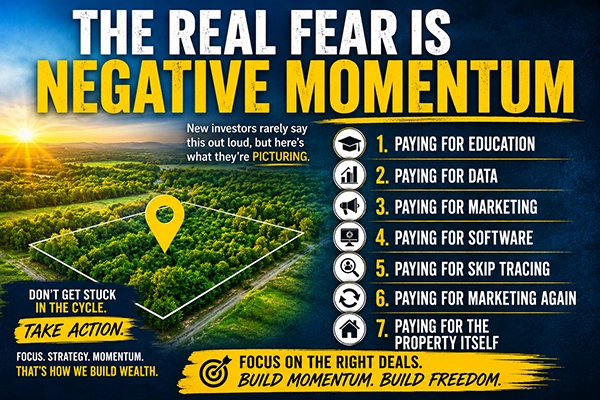
New investors rarely say this out loud, but here’s what they’re picturing (how do I know, because I’ve been there):
Paying for education
Paying for data
Paying for marketing
Paying for software
Paying for skip tracing
Paying for marketing again
Paying for the property itself
All while deals still feel theoretical.
The fear isn’t the cost.
The fear is money going out every month with no proof it’s coming back.
That’s not irrational. That’s pattern recognition from bad businesses.
But land flipping doesn’t break people because it’s expensive. It breaks people because the feedback loop is delayed, and most people underestimate how long they need to stay consistent before results show up.
The Better Question to Ask Yourself
The wrong question is:
“How much is this going to cost me?”
Even this question misses the point:
“How can I do this if money weren’t the issue?”
The right question is:
“How long will I realistically stick to this if I don’t see a profit?”
Because if the answer is “three months” or “until I get discouraged,” the outcome is already decided.
Land flipping doesn’t reward dabbling. It rewards consistency over time.
Why I Believe a One-Year Commitment Is Non-Negotiable
I truly believe you have to commit to this for one solid year.
Not casually.
Not part-time in your head.
A real commitment.
Here’s the pattern I’ve consistently seen in the real world:
Months 1–3: setup, learning, confusion
Months 4–6: activity, conversations, frustration
Months 7–9: the corner gets turned
This isn't a theory. This is an observation.
I’ve watched people sit in the red for months, questioning everything, and then suddenly cross into the black. And when it happens, it almost never happens slowly.
It usually comes as a single wire.
A real one.
Five figures.
Clears the account.
That moment isn’t excitement. It’s relief.
Relief that they didn't quit.
Relief that the time, effort, and money weren't wasted.
Relief that the business finally feels real.
Relief that it worked-and that they can finally put their "fill in the blank" behind them. Maybe it's the doubting spouse. Maybe it's the snickering colleagues. Maybe it's the friends or family members who never quite understood why you chose to pursue land flipping in the first place.
If you don't stick with it long enough, you'll never get the chance to say, "I told you so." But more importantly, you'll never get the opportunity to prove to yourself that you were right all along-that you were capable of building something meaningful if you simply refused to quit.
Most people never experience that moment-not because they lacked the ability to succeed, but because they stopped too soon.
This Is Why “I Don’t Have Enough Money” Misses the Point
When you understand the timeline, the money objection starts to fall apart.
The real risk isn’t starting with too little money.
The real risk is running out of runway before momentum shows up.
Cash pressure shortens patience. It causes people to:
Skip marketing
Start and stop campaigns
Hesitate when they should be consistent
Quit right before things turn
That’s why money matters-but not as a prerequisite. It matters as a way to protect commitment.
Marketing Is the First Bottleneck, Not Deals
In land flipping, the first meaningful cost isn’t buying land.
It’s marketing.
If you can’t consistently reach sellers and generate leads, nothing else matters.
The mistake most people make is assuming marketing must be funded out of pocket, month after month, with personal cash. That creates pressure. Pressure leads to inconsistency. Inconsistency kills results.
Early on, I stopped thinking of marketing as an expense and started treating it as infrastructure. Something that needed to be funded in a way that allowed me to stay consistent long enough for the system to work.
That’s when I used 0% interest business credit cards to fund marketing instead of cash.
Not to gamble.
Not to move faster than I should.
But to give myself runway.
Marketing produces leads.
Conversations with leads produce deals.
Deals produce exits.
Exits pay off the marketing and put extra money in your pocket.
That loop only works if you stay in it long enough.
Several years ago, after reading a blog post from someone I follow and trust, I learned about a company that provides a done-for-you service to help entrepreneurs secure up to six figures-or even more, if needed-in 0% interest business credit card funding. I decided to use their service myself and was extremely pleased with the experience. In fact, I ended up obtaining far more available credit than I needed, which is a good problem to have. It was a gamechanger at the time to not have to dip into my own pocket for marketing dollars. If you're interested in learning more about their service, you can visit LandBossCredit.com.
Deals Don’t Have to Be Self-Funded Either
Another belief that keeps people stuck is:
“I need money to buy land.”
Sometimes that’s true. Often it isn’t.
Land deals can be funded in multiple ways:
Seller financing (you buy on payments instead of cash)
Money partners (people like me are happy to fund all your deals)
Private money (got a rich uncle or a colleague with extra money looking for a passive return)
Transactional funding (aka flash cash, works great for double closes)
Deal-by-deal funders (there are over 40 funders to my knowledge in the land space)
Good deals attract money. Put simply, if you can get a property under contract with enough equity built into the deal, there's a strong likelihood that it will qualify for funding through a deal funder.
If you can price conservatively, protect the downside, and demonstrate a clear exit strategy, finding the money is often easier than you think. In my experience, the real challenge isn't raising money-it's negotiating the purchase price well enough to create a deal worth funding in the first place.
Why I Removed the Money Excuse Entirely
After years of doing this-and watching capable people stall for no reason other than money anxiety-I decided to eliminate the money excuse altogether.
For marketing, I used a company to secure 0% interest business credit cards so I could stay consistent without draining my own cash. If you want to see who I use and recommend to my coaching clients you can learn more about them at LandBossCredit.com
So, that takes care of the "How do I afford marketing?" question.
The next question people usually ask is, "How do I afford to buy properties?"
In the beginning, I used my own money. Eventually, I reached a point where I had deployed all of the money I had available into deals. I found myself in a cycle of having to wait for inventory to sell before I could buy another property. In other words, my growth was being limited by the amount of money I had access to.
What I didn't realize at the time was that I had a major blind spot when it came to using other people's money.
I wasn't always open to the idea. In fact, early on I had the mindset of, "Why would I split my deals with anyone else?" I wanted 100% ownership and 100% of the profits. Looking back, that way of thinking kept me playing smaller than I needed to.
Then one night, while watching Shark Tank with my wife, I heard Mark Cuban ask an entrepreneur a question that completely changed my perspective: "Would you rather own 50% of a watermelon or 100% of a grape?"
That simple analogy challenged the way I had been thinking about partnerships and using other people's money. Up until that point, I had been limiting myself by insisting on owning everything myself. I eventually realized that owning a smaller piece of a much larger opportunity was often far better than owning all of something small-or worse, passing on great opportunities because I didn't have enough money to pursue them.
At the time, I was often hamstrung by a lack of money. I had deals I wanted to pursue but couldn't because I simply didn't have the funds available. It finally clicked: if a billionaire investor (Mark Cuban) viewed partnerships this way, maybe I needed to rethink my approach.
I realized that owning a smaller piece of a much larger opportunity was often far better than owning all of a small one-or worse, missing out on great deals entirely because I didn't have the money to act. That shift in mindset opened the door for me to scale my business much faster.
As I grew my land business, I relied heavily on private lenders to fund acquisitions. Over time, I accumulated enough money not only to fund my own deals but also to help fund opportunities for members of my community and coaching students.
If you're interested in leveraging other people's money the same way I did, you can apply for funding through LandBossFunding.com. If you've got a great deal that fits our current lending criteria, we'd be happy to take a look. And if it's not a deal we're able to fund ourselves because of the market or property type, I'll gladly connect you with one of the trusted money partners in my network who may be a better fit.
The reality is that money constraints don't have to keep you from pursuing land flipping or great opportunities. Sometimes, owning a piece of a watermelon is exactly what allows you to build an orchard.
That solves the two real pressure points:
Staying consistent long enough
Not passing on good deals
Which means money no longer has to be the reason someone quits early.
What Actually Determines Success
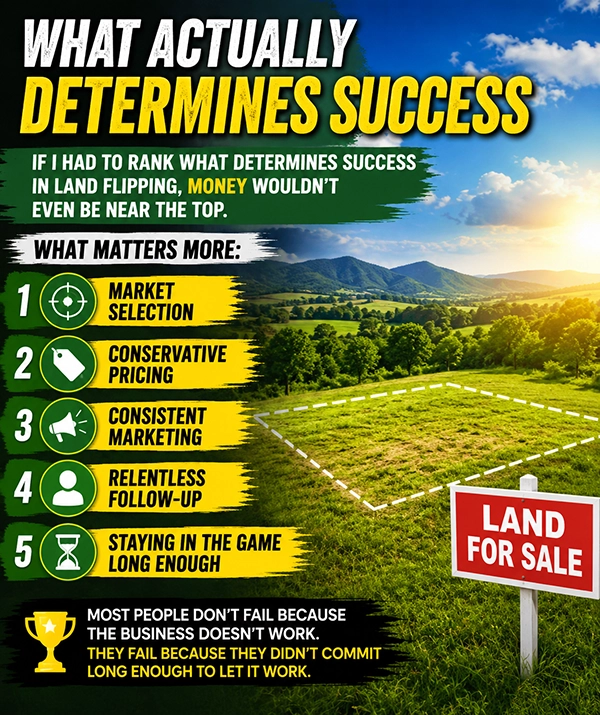
If I had to rank what determines success in land flipping, money wouldn’t even be near the top.
What matters more:
Market selection
Conservative pricing
Consistent marketing
Relentless follow-up
Staying in the game long enough
Most people don’t fail because the business doesn’t work.
They fail because they didn’t commit long enough to let it work.
The Bottom Line
Stop saying:
“I can’t do this because I don’t have enough money.”
Start asking yourself:
"How can I structure this so I can stay consistent for an entire year and give myself a fair shot at making this land flipping thing work?"
If you solve that problem, the rest becomes manageable.
And if you stay consistent long enough, that first wire has a way of showing up.
That’s when everything changes.
Land Flipping FAQs
Do I need a lot of money to start flipping land?
Less than most people think. The real challenge isn't the money itself it's staying consistent long enough for the business to work. Marketing can be funded through 0% interest business credit cards, and deals can be funded through seller financing, private money, or deal funders.
How long does it take to make money flipping land?
Most people see months 1-3 spent learning and setting up, months 4-6 spent in frustration with little to show for it, and months 7-9 is when things often turn. The first real deal usually shows up as one significant payout, not a slow trickle.
Can I get funding if I don't have my own money to buy land?
Yes. If you can negotiate a deal with enough equity built in, it has a strong chance of qualifying for funding through a deal funder, private lender, or money partner. The challenge isn't finding money it's finding a deal good enough to attract it.
What is the biggest reason people fail at land flipping?
They quit too soon. Most people don't fail because the business doesn't work they fail because they stop before momentum has a chance to build. A one-year commitment is what separates people who succeed from people who give up.
Should I use my own cash to fund marketing?
Not necessarily. Treating marketing as an ongoing personal expense creates pressure that leads to inconsistency. Many investors use 0% interest business credit cards to fund marketing so cash flow pressure doesn't force them to quit right before things turn around.


